
Διαβάστε το άρθρο στα ελληνικά.
Αυθαίρετα and τακτοποίηση: the unpermitted structure that voids a Greek deed
On this page
What ν. 4495/2017 calls an αυθαίρετο, the five κατηγορίες and the four still open, what a τακτοποίηση actually buys, the ground on which nothing can ever be settled, the βεβαίωση μηχανικού and the Ηλεκτρονική Ταυτότητα Κτιρίου, and how to cost it before you offer.
This guide is a preliminary screen for a purchase or permit question, not legal, surveying, engineering or tax advice; read the full scope and limits before relying on it.
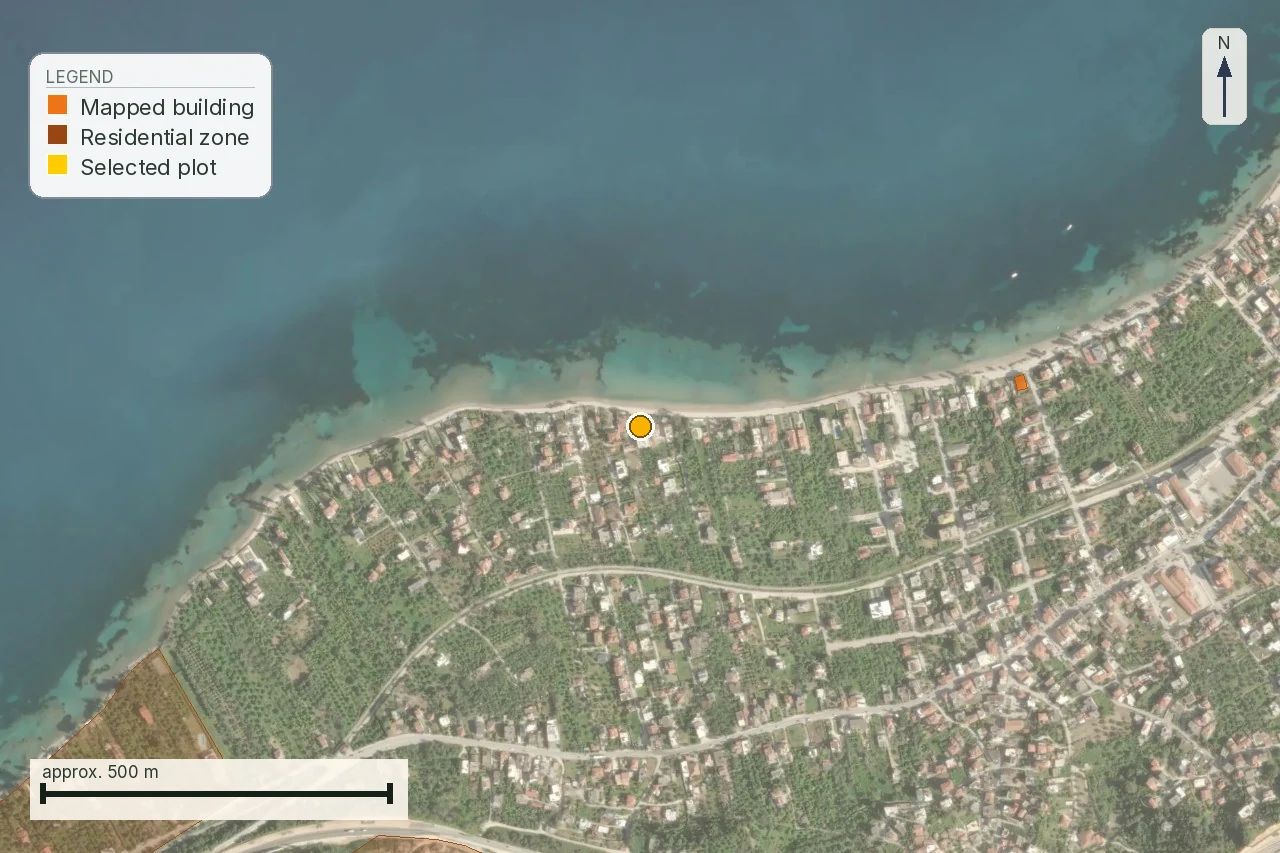
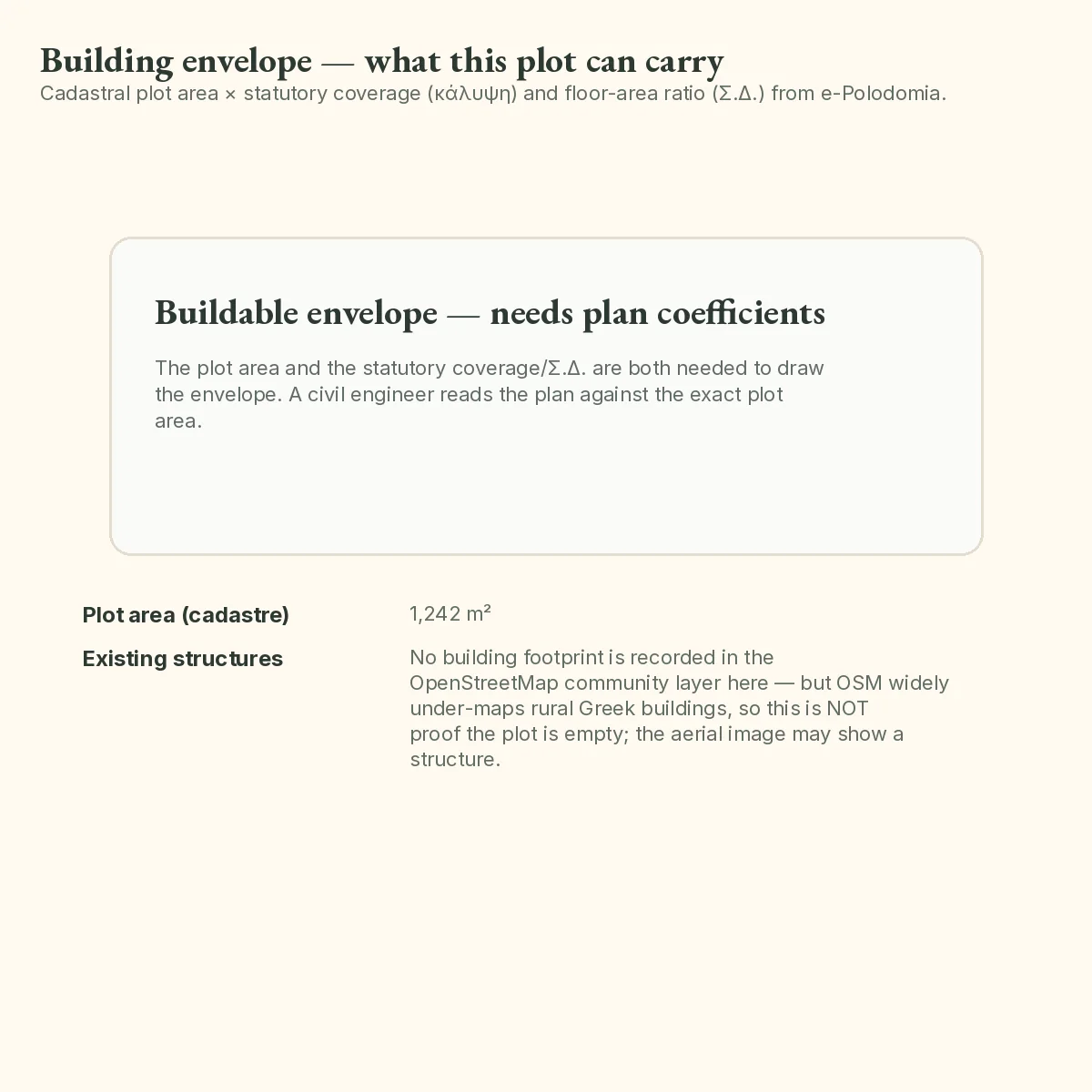
Have a specific plot in mind? Every check in this guide can be run on it, with source and date, for EUR 29 total · VAT included. Pin it on the map →
A Greek sale signed since 3 November 2017 carries an engineer’s certificate saying either that nothing stands on the property or that what stands has been declared. The duty sits in άρθρο 83 παρ. 1 ν. 4495/2017 and it is drawn round a defined set of transactions: every δικαιοπραξία εν ζωή that transfers or creates a right in rem, which takes in a purchase, a γονική παροχή and a gift, and leaves inheritance on a different route. Where an unpermitted structure stands, the transfer itself is «απαγορεύεται και είναι απολύτως άκυρη», forbidden and absolutely void, under άρθρο 82 ν. 4495/2017 (ΦΕΚ Α΄ 167/3.11.2017), now άρθρο 367 ν. 5306/2026.
That is why an unpermitted extension on a Greek house first surfaces at the notary, and why so many purchases stall a fortnight before signature. The certificate is the moment somebody finally measures the building against its permit. Everything else that can stop a Greek purchase is laid out in the restriction stack; this page is about the one that turns up most often on a house with a garden.
What the law means by αυθαίρετο
The definition is broad. Read it in the original: Άρθρο 366 ν. 5306/2026, carrying over άρθρο 81 ν. 4495/2017: «Αυθαίρετη κατασκευή ορίζεται κάθε κατασκευή ή εγκατάσταση, η οποία εκτελείται ή έχει εκτελεστεί χωρίς την απαιτούμενη οικοδομική άδεια». Any construction or installation carried out without the permit it needed. The same chapter treats an unauthorised change of use the same way, which catches the ground-floor store that became a flat and the farm shed that became guest rooms without a brick moving.
Two things follow that a foreign buyer rarely expects. The first is that the obstacle travels with the property. Άρθρο 367 forbids the transfer of an «ακίνητο στο οποίο έχει εκτελεστεί αυθαίρετη κατασκευή». The prohibition attaches to the property itself, so a new owner arrives to a house that cannot be sold on and a bill for clearing it. That is not the same as inheriting the builder’s criminal liability: the fines for erection and retention and the ποινικές κυρώσεις of άρθρο 381 attach to conduct, and we did not open a provision that allocates them between a seller and a buyer, so this page does not say who pays them. The second is that the settlement schemes are closed in time. The whole apparatus of categories and fines applies only to work completed before 28 July 2011, and anything after that date is outside all of it.
A word on the two numbers this page prints for almost every provision. The αυθαίρετα chapter was carried into the Κώδικας Χωροταξίας και Πολεοδομίας «Νικόλαος Ταγαράς» (ν. 5306/2026, ΦΕΚ Α΄ 88/8.6.2026) in June 2026, and the shift is not a constant: άρθρο 82 became άρθρο 367 and άρθρο 96 became άρθρο 383, two different distances inside one chapter. Each pair printed here was checked by opening the Κώδικας article and reading its heading and first sentence against the ν. 4495/2017 one, and the Κώδικας carries its own concordance annex for anyone who wants to repeat the exercise. Where a pair was not checked, only the ν. 4495/2017 number appears.
The five categories, and the four that are still open
Άρθρο 96 ν. 4495/2017, now άρθρο 383 ν. 5306/2026, sorts everything built before 28 July 2011 into five categories. The first two are age-based. Κατηγορία 1 covers work completed before 9 June 1975 and settles it for a παράβολο of €250 «και χωρίς την καταβολή ενιαίου ειδικού προστίμου», with no fine at all. Κατηγορία 2 does the same for work finished before 1983, with the fine payable. Κατηγορία 3 is a closed list of minor breaches, also €250 and no fine: a pergola up to 50 m², a storage room up to 15 m², a fence a metre over, a balcony 20% out.
Κατηγορία 4 is the one that decides most real houses. It admits breaches of the planning figures up to 20% of κάλυψη, δόμηση and ύψος; or up to 40% of κάλυψη and δόμηση with 20% of ύψος provided the excess stays under 250 m² for a dwelling and 1,000 m² for the building as a whole; or, on a property that already has a building permit, any excess up to 50 m² of floor area.
Κατηγορία 5 is the residual class, defined as everything not caught by the first four, and its treatment is different: «αναστέλλεται για τριάντα (30) έτη η επιβολή κυρώσεων». Thirty years of suspension rather than a permanent exemption.
Here is the fact that almost no consumer article carries, and it changes what a buyer should do. Άρθρο 102 παρ. 1, now άρθρο 389 ν. 5306/2026, closed the general window on 30 September 2020 and reopened only part of it: «Μετά από την παρέλευση της προθεσμίας αυτής και μέχρι τις 31 Μαρτίου 2028 επιτρέπεται η υπαγωγή στις διατάξεις του παρόντος μόνο για αυθαίρετες κατασκευές και αλλαγές χρήσης των κατηγοριών 1 έως και 4». Category 5 has not been available since 1 October 2020. A structure that falls outside categories 1 to 4 and was built before 2011 therefore has no way into this scheme today, whatever anyone is willing to pay, and a seller who says otherwise is describing the window as it stood before October 2020.
Two limits belong with that sentence, because it is the one most likely to be argued with. What we checked is this chapter and its own closing date; we did not read every planning statute passed since, and if some later instrument has reopened κατηγορία 5 we did not find it. And the closure is of the settlement route alone. Legalisation under άρθρο 106 ν. 4495/2017, now άρθρο 393 ν. 5306/2026, is untouched by the deadline and stays open wherever the structure could lawfully have been permitted, which is a question about the planning terms on the plot rather than about dates.
Anything built after 28 July 2011
Άρθρο 381 ν. 5306/2026 disposes of it in one sentence: «Οι αυθαίρετες κατασκευές που πραγματοποιούνται μετά τις 28.7.2011 κατεδαφίζονται υποχρεωτικά και επιβάλλονται πρόστιμα ανέγερσης και διατήρησης αυθαιρέτων, καθώς και ποινικές κυρώσεις». Compulsory demolition, a fine for putting it up, a further fine for every period it stays up, and criminal liability alongside. No category takes it and no παράβολο changes that.
For a buyer there is nothing here to negotiate over. The transfer stays void while the structure stands, no settlement is available at any price, and the two exits are demolition or an άδεια νομιμοποίησης under άρθρο 106, now άρθρο 393, where the structure could lawfully have been permitted in the first place. Which of the two applies is decided by the planning terms on the plot, whatever the age of the thing standing there. So the first job is documentary: establish when it was built.
Τακτοποίηση and νομιμοποίηση are two different papers
Άρθρο 97 ν. 4495/2017, now άρθρο 384 ν. 5306/2026, says what payment buys, and the sentence has two halves that are usually quoted apart: «Μετά την καταβολή του ενιαίου ειδικού προστίμου ή του προβλεπόμενου σχετικού παραβόλου, αναστέλλεται η κατεδάφιση, η επιβολή κάθε κύρωσης και η είσπραξη προστίμου για το χρονικό διάστημα που προβλέπεται στον παρόντα Κώδικα ή η κατασκευή εξαιρείται οριστικά από την κατεδάφιση, ανάλογα με την κατηγορία». Demolition, every other sanction and collection of the fine all stop, and which of the two outcomes you get depends on the category: a suspension for a stated period, or permanent exemption. The categories themselves say which is which. Each of κατηγορίες 1 to 4 ends «εξαιρούνται οριστικά από την κατεδάφιση», κατηγορία 4 in the fullest terms: «εξαιρούνται οριστικά από την κατεδάφιση, μετά την υπαγωγή, την καταβολή του σχετικού παραβόλου και την καταβολή του ενιαίου ειδικού προστίμου». Κατηγορία 5 is the only one carrying the thirty-year clock. What none of them does is issue a permit.
The distinction stays theoretical until the day you apply for one. A settled structure has no building permit covering it, so it cannot simply be drawn into the next one. The route into permitted status is άρθρο 106 ν. 4495/2017, now άρθρο 393 ν. 5306/2026, an άδεια νομιμοποίησης, and it is available only where the structure could lawfully have been permitted in the first place. Where it is available, read the provision as the conditional it is: «εφόσον καταβληθεί το παράβολο […] και εκδοθεί η σχετική οικοδομική άδεια νομιμοποίησης εντός τεσσάρων (4) ετών», then «δεν οφείλεται άλλο πρόστιμο». Both limbs have to happen inside the four years for the relief to follow. The provision does not promise that the ΥΔΟΜ will issue in time and does not say who carries a delay that is the office’s, so an owner relying on it is carrying a scheduling risk that belongs in the price. Where legalisation is not available, the building stays settled and unpermitted for as long as you own it.
What happens at the end of the thirty years for a κατηγορία 5 structure is not answered by the provision we opened, and this page does not print a guess. The practical reading in the market is that the clock is long enough not to matter to a purchase today and short enough to matter to a grandchild; the useful step is to ask the engineer whether the structure could be moved into κατηγορία 4 or legalised outright, which the engineer answers from the permit drawings.
Older files still count. Declarations made under ν. 4014/2011 and ν. 4178/2013 did not lapse when ν. 4495/2017 arrived, and άρθρο 102 παρ. 1 names «των κατηγοριών 1 έως και 4 του άρθρου 9 του ν. 4178/2013 (Α΄174)» alongside the current ones. A single property can therefore carry two or three generations of declaration, each with its own drawings, and the check has to cover all of them.
A mortgage adds a condition that no provision on this page contains. Nothing in ν. 4495/2017 or in the Κώδικας tells a bank when it may lend; άρθρο 82 bars the transfer, and the credit decision sits outside it. What we can report is what we have seen: Greek lenders ask for the settlement to be complete and paid in full, with the Ηλεκτρονική Ταυτότητα Κτιρίου filed, before they release funds, and an instalment plan still running is a common reason a drawdown slips. We are describing market practice we have observed rather than a rule we can cite, and no bank publishes its credit policy, so treat it as a question with a cheap answer: ask your branch for its condition list in writing before you agree a completion date with the seller.
The ground where nothing can be settled
Άρθρο 89 ν. 4495/2017, now άρθρο 374 ν. 5306/2026, lists the places where the scheme simply does not apply, whatever the date, the category or the willingness to pay. The list runs to eighteen lettered cases. The ones a buyer of rural or coastal land meets are these:
- περ. α, «σε εγκεκριμένο κοινόχρηστο χώρο της πόλης ή του οικισμού», a public space of the town or settlement; and περ. β, land ceded to common public use.
- περ. ε, «σε δημόσιο κτήμα», state land.
- περ. στ, «σε δάσος, σε δασική ή αναδασωτέα έκταση». Forest, forest land or land declared for reafforestation. This is the most absolute ground on the list, and it is decided by the δασικός χάρτης, not by what grows there.
- περ. ζ and η, «στον αιγιαλό και στον παλαιό αιγιαλό» and the ζώνη παραλίας, with narrow exceptions.
- περ. θ and ι, archaeological sites, Zone Α absolutely and outside Zone Α conditionally.
- περ. ιγ, a ρέμα, a critical coastal zone or a protected area.
The practical consequence is worth stating plainly. If the structure sits on one of these grounds, no engineer can settle it, no fine will help, and the property cannot be transferred with it standing. That is a different conversation from a price negotiation about a fine.
Each of those grounds has its own office and its own paper, and they are answered separately. The forest character is read on the official δασικός χάρτης application and certified by the Διεύθυνση Δασών; the αιγιαλός line, where one has been fixed, is held by the local Κτηματική Υπηρεσία; archaeological zones are answered by the Εφορεία Αρχαιοτήτων. None of the answers substitutes for the others, and the engineer’s certificate does not contain any of them.
The certificate attached to the deed, and what a false one costs
Άρθρο 83 παρ. 1, now άρθρο 368 ν. 5306/2026: «Σε κάθε δικαιοπραξία εν ζωή περιλαμβανομένης και της δωρεάς αιτία θανάτου, που συντάσσεται μετά την έναρξη ισχύος του παρόντος και έχει ως αντικείμενο τη μεταβίβαση ή τη σύσταση εμπράγματου δικαιώματος σε ακίνητο ή και σε ακίνητο χωρίς κτίσμα, επισυνάπτεται υπεύθυνη δήλωση του ιδιοκτήτη και βεβαίωση μηχανικού». Note the phrase «ή και σε ακίνητο χωρίς κτίσμα»: the obligation covers bare land as well, where the engineer certifies that no building stands on it.
The scope is every δικαιοπραξία εν ζωή, so a γονική παροχή or a gift inside a family needs the same certificate as a sale, and a property that has passed between relatives is not for that reason cleaner than one bought at arm’s length. Acceptance of an inheritance is not an inter vivos legal act and does not fall within Article 83: an heir accepting property with an undeclared structure does not first need an engineer’s certificate to register it in their name. That does not solve the problem; it postpones it. The prohibition in Article 367 attaches to the property rather than to the person who built, so the heir receives the same obstacle: when they later sell, gift or mortgage the property, they need the same certificate and must either declare the structure or demolish it first. This article does not establish what the notary requires for the acceptance itself, the tax-filing deadline or the documents requested by the tax office; obtain inheritance-law advice before accepting anything.
Three mechanics matter to a buyer. The βεβαίωση is filed electronically and receives a unique number that is quoted in the deed, so it can be checked rather than taken on trust. It has a short life: «Οι ανωτέρω βεβαιώσεις των μηχανικών έχουν ισχύ δύο (2) μηνών από την υπογραφή τους», two months from signature. And a false one is a criminal matter, not a professional embarrassment. Άρθρο 83 παρ. 12 puts engineers who issue an inaccurate certificate, and notaries, registrars and heads of cadastral offices who draw or register a deed without it, on the same penalty: «ποινή φυλάκισης τουλάχιστον έξι (6) μηνών και χρηματική ποινή από τριάντα χιλιάδες (30.000) μέχρι εκατό χιλιάδες (100.000) ευρώ».
Η Ηλεκτρονική Ταυτότητα Κτιρίου
For a property with a building, the βεβαίωση is no longer the whole answer. The Ηλεκτρονική Ταυτότητα Κτιρίου is a permanent electronic file for the building, opened and completed by an authorised engineer, from which a Πιστοποιητικό Πληρότητας is issued. Άρθρο 344 ν. 5306/2026, carrying over άρθρο 55 ν. 4495/2017, fixes the moment: for ordinary buildings and divided properties, «η υποβολή της ταυτότητας γίνεται κατά τη μεταβίβαση του κτιρίου ή της αυτοτελούς διηρημένης ιδιοκτησίας, οπότε και η σχετική δήλωση για την ταυτότητα προσαρτάται υποχρεωτικώς στο συμβόλαιο της μεταβίβασης της κυριότητας». Public buildings, hotels over 300 m², schools, clinics and fuel stations were in a separate category with a five-year deadline of their own.
The commencement dates are commonly reported wrongly, including in the earlier version of this page. Άρθρο 351 ν. 5306/2026 records both: the register opened on «1η.2.2021» by ministerial decision ΥΠΕΝ/ΔΕΣΕΔΠ/7547/104/26.1.2021 (ΦΕΚ Β΄ 287), and a transitional route allowed a transfer to proceed on the old owner’s declaration plus engineer’s certificate «από την 1η.10.2021 έως και την 31η.12.2022». So a deed for a building signed from 1 January 2023 onwards needs the identity file. A deed for bare land does not; it needs the άρθρο 83 certificate.
What it costs the buyer is a fair question with an unsatisfying answer. There is no state fee for the identity file itself. The cost is the engineer’s fee, and since άρθρο 7 ν. 3919/2011 (ΦΕΚ Α΄ 32/2.3.2011) engineers’ fees are «καθορίζεται ελεύθερα με έγγραφη συμφωνία», set freely by written agreement, with the old statutory minima abolished as minima. We did not establish a published price band for the ταυτότητα that we would put our name to, so this page does not print one. Ask two engineers for a written quotation naming the building and the drawings that already exist.
Costing it before you make an offer
The fine has a formula and you can run it. Άρθρο 100 παρ. 1 ν. 4495/2017, now άρθρο 387 ν. 5306/2026: the ενιαίο ειδικό πρόστιμο is «το εμβαδόν της επί την τιμή ζώνης στην περιοχή του ακινήτου, ανεξαρτήτως της χρήσης αυτού, σύμφωνα με το σύστημα αντικειμενικών αξιών του Υπουργείου Οικονομικών της 20.1.2016, επί το συντελεστή δεκαπέντε τοις εκατό (15%) και επί τους συντελεστές των σχετικών ενδείξεων -τετραγωνιδίων, που ορίζονται στον πίνακα του Παραρτήματος Α΄». Area, times the zone price frozen at January 2016, times 15%, times a set of coefficients for the kind of breach. The codified version keeps the formula word for word and re-addresses the table: άρθρο 387 sends you to «τον πίνακα του Παραρτήματος του άρθρου 399», which is where the same sheet now lives.
Παρ. 4 then scales the result by age: 15% of the fine for work proved to predate 1 January 1983, 60% for 1983 to 1993, 80% for 1993 to the end of 2003. The ladder stops there, and that matters more than the three figures do. Work finished between 1 January 2004 and 28 July 2011 falls in none of the bands, so on the text of παρ. 4 it carries the fine at the full 15% of zone value with no age reduction at all, and that period is a large share of what is still settleable today. A 1990s veranda and a 2007 veranda of the same size in the same zone are not the same bill. The παράβολο is separate and flat, from άρθρο 99, now άρθρο 386: €250 up to 100 m², €500 to 500 m², €1,000 to 2,000 m², €4,000 to 5,000 m², €10,000 above that.
Two rows on that drawing are open. Close both before an offer: The first is the coefficient table. It is not a list of numbers but a form: the annex is headed «Φύλλο καταγραφής αυθαίρετης κατασκευής» and is published as a facsimile sheet rather than as text, and the engineer ticks its τετραγωνίδια inside the ΤΕΕ system, which then multiplies them into the fine. We have not read the sheet and print no coefficient from it. What you can do instead is ask for the completed one: the printed φύλλο καταγραφής shows every coefficient the system applied to your building, and it is the only place that row becomes legible. Ask for it together with the declaration before you agree a price.
The second row is open in the statute. Άρθρο 102 παρ. 3, now άρθρο 389 παρ. 3, surcharges a late filing in six lettered bands, and the last of them applies «κατά σαράντα τοις εκατό (40%)» to a declaration filed «από την 1η.10.2024 μέχρι και τις 31.3.2026». Παρ. 1 sends every filing made after 1 October 2020 to «τις περ. β΄ έως στ΄ της παρ. 3» and keeps the window open «μέχρι και τις 31.3.2028». Read together, a declaration filed in August 2026 sits inside the filing window and outside every band. We read the Κώδικας text on 1 August 2026 and found no band covering a date after 31 March 2026 and no amending provision adding one. For a buyer that produces a bounded answer rather than a blank: the fine is what the formula gives, and the surcharge is somewhere between nothing and the 40% of the expired band. Have the engineer run the declaration in the system and print what it charges before you commit to a figure, and make the difference a term of the offer.
| Ask the seller for | What you are checking |
|---|---|
| The οικοδομική άδεια with every αναθεώρηση | The permitted floor area, against which everything else is measured. |
| Every δήλωση υπαγωγής, with its category and its system number | Which category was claimed, and whether the file was completed rather than merely opened. |
| The payment receipts for the παράβολο and every instalment | A settlement paid in instalments is still running, and the bank will find that before you do. |
| The as-built κατόψεις from the identity file | Whether the drawings match the rooms you walked through. |
| The Πιστοποιητικό Πληρότητας, dated | That the identity file is closed, not open. |
When the δήλωση exists and the drawings do not match the building
This is the ordinary failure, and it is more common than an undeclared structure. A settlement was filed years ago by an engineer working from an old sketch; the veranda was 42 m² on paper and is 58 m² on the ground; the category claimed was 4 and the real excess puts it in 5. The declaration is genuine, paid and visible in the file, and it is wrong.
The route is administrative and it is named. Άρθρο 107 παρ. 10 ν. 4495/2017, now άρθρο 394 παρ. 9 ν. 5306/2026: «Η ανάκληση υπαγωγών αυθαιρέτων γίνεται από το αρμόδιο Τοπικό Παρατηρητήριο. Μέχρι τη σύσταση των παρατηρητηρίων, αρμόδιες είναι οι Υ.Δομ. Προσφυγή κατά των ανακλήσεων υπαγωγών, ασκείται στο ΠΕ.ΣΥ.ΠΟ.Θ.Α. και μέχρι την συγκρότηση και λειτουργία τους από το οικείο ΣΥ.ΠΟ.Θ.Α.» The observatories are the body the statute intends; in most of the country the Υπηρεσία Δόμησης of the municipality is doing the work, and an appeal goes to the regional planning council. Read what that provision does and does not carry. It names one power, revocation, and the office that holds it. It says nothing about correcting a declaration in place, we found no provision that either allows or forbids a corrective filing, and the electronic system is the practical answer to that: ask the engineer who would have to run it. The provision also sets no time limit for the προσφυγή, so do not take a period from this page.
Two more traps sit in the same place. A declaration is not finished when the παράβολο is paid: άρθρο 99 gives the engineer «εντός εβδομήντα δύο (72) μηνών από την πληρωμή του παράβολου» to complete the electronic filing of the supporting documents, and files opened years ago and never finished are a known category of unpleasant surprise. And for any settlement made after 1 October 2020, άρθρο 102 παρ. 1 closes with a condition that is easy to read past: «η καταχώριση της ταυτότητας του κτιρίου ή της διηρημένης ιδιοκτησίας στο ηλεκτρονικό μητρώο του άρθρου 62 του παρόντος αποτελεί όρο για την επέλευση των συνεπειών της υπαγωγής». Without the identity file registered, the settlement does not produce its effects.
Before you sign, the repair is measurement. Your own engineer, on site, with the permit drawings and the identity file open, comparing three things: what the permit allowed, what the settlement declared, and what is standing. After you sign, the remedies are slower. The engineer who certified falsely faces άρθρο 83 παρ. 12. Whether you have a claim against the seller depends on what the contract said and is a question for a Greek lawyer. The measurement belongs before the deposit.
Reading a listing, phrase by phrase
| What it says | What to ask |
|---|---|
| “Τακτοποιημένο, all legal” | Under which category and which law. A ν. 4178/2013 declaration and a ν. 4495/2017 one are different files, and both can be incomplete. |
| “Small αυθαίρετο, easy to settle” | Completed before 28 July 2011? If not, no category applies. If yes, categories 1 to 4 only, and only until 31 March 2028. |
| “Ταυτότητα Κτιρίου in progress” | Ask for the Πιστοποιητικό Πληρότητας with its date. The notary needs the issued certificate, and an open file has not produced one. |
| “The fine has been paid” | In full or in instalments? And was the supporting file completed within the 72 months άρθρο 99 allows? |
| “Only a shed, near the beach” | Where is the αιγιαλός line, and has it been drawn at all? Άρθρο 89 περ. ζ excludes what stands on it, and an undelimited shore leaves the question open. |
What to ask for, in order
- Establish the ground first. Forest, coast, stream and archaeology decide whether anything there is settleable at all, and they are answerable from public data before anyone visits.
- Get the permit and every settlement declaration, with dates, categories and system numbers, and read them against each other rather than against the seller’s summary.
- Have your own engineer measure the building against the as-built drawings in the identity file, before the deposit.
- Make a dated Πιστοποιητικό Πληρότητας a condition of the contract, alongside the άρθρο 83 certificate with its unique number.
- Budget the whole file. The fine is one line of it. The παράβολο, the engineer, the survey, the surcharge nobody can quote you and the months of delay are the rest.
The number that decides most of this is the date on the building, and it is the one fact the seller usually cannot produce a document for. Practitioners use aerial imagery, the permit file and the neighbours’ deeds to establish it. Do that before you make an offer. A structure finished on 27 July 2011 can still go into κατηγορία 4 if its excess fits; the same structure finished on 29 July 2011 falls under άρθρο 381, where demolition is compulsory and no παράβολο changes it.
Common questions
Can I still τακτοποιήσω an αυθαίρετο in 2026?
Only if it was completed before 28 July 2011 and falls in κατηγορία 1 to 4 of άρθρο 96 ν. 4495/2017, now άρθρο 383 ν. 5306/2026. Άρθρο 102 παρ. 1 allows those categories «μέχρι τις 31 Μαρτίου 2028». Κατηγορία 5, the residual class that used to catch everything else, has been shut out of that window since 1 October 2020 and we found no later provision reopening it, and nothing built after 28 July 2011 has ever been eligible.
Is a τακτοποιημένο house legal?
It is settled. Άρθρο 97 ν. 4495/2017, now άρθρο 384 ν. 5306/2026, suspends demolition, sanctions and collection of the fine «ή η κατασκευή εξαιρείται οριστικά από την κατεδάφιση, ανάλογα με την κατηγορία», and each of κατηγορίες 1 to 4 in άρθρο 96, now άρθρο 383, ends «εξαιρούνται οριστικά από την κατεδάφιση». No building permit has been issued for the structure, though. To bring it inside one you need an άδεια νομιμοποίησης under άρθρο 106, now άρθρο 393 ν. 5306/2026, available only where the structure could lawfully have been permitted. Where it is, the provision is conditional on both limbs: the παράβολο paid and the permit actually issued inside four years, and only then is no further fine owed.
What happens if I buy a property with an undeclared αυθαίρετο?
In principle you cannot: άρθρο 82 ν. 4495/2017, now άρθρο 367 ν. 5306/2026, makes the transfer «απολύτως άκυρη», absolutely void, and the notary who draws it without the engineer's certificate faces at least six months' imprisonment and a fine of €30,000 to €100,000 under άρθρο 83 παρ. 12. In practice the common failure is a misdeclared structure: the file exists, and the drawings understate what is standing.
When did the Ηλεκτρονική Ταυτότητα Κτιρίου become compulsory for a sale?
The register opened on 1 February 2021 under ministerial decision ΥΠΕΝ/ΔΕΣΕΔΠ/7547/104/26.1.2021 (ΦΕΚ Β΄ 287), and a transitional route let a transfer proceed on the owner's declaration plus an engineer's certificate «από την 1η.10.2021 έως και την 31η.12.2022», per άρθρο 351 ν. 5306/2026. A deed for a building signed from 1 January 2023 needs the identity file and its Πιστοποιητικό Πληρότητας. Bare land does not; it needs the άρθρο 83 certificate.
How much does a τακτοποίηση cost?
The fine is area × the 20.1.2016 τιμή ζώνης × 15% × the coefficients of the annex, under άρθρο 100 παρ. 1, now άρθρο 387, then scaled by age: 15% of it for work before 1983, 60% for 1983-1993, 80% for 1993-2003, and nothing for work after 31.12.2003, which pays in full. The παράβολο is flat, from €250 up to 100 m² to €10,000 above 5,000 m². The engineer's fee is freely agreed under άρθρο 7 ν. 3919/2011. A 42 m² breach in a €1,000/m² zone, built in 1995, works out at €5,040 of fine plus €250. Two multipliers stay open: the coefficients, which are ticked on the «Φύλλο καταγραφής αυθαίρετης κατασκευής» inside the ΤΕΕ system, and the late-filing surcharge, for which no band covers a filing made after 31 March 2026. Ask the engineer to run it and print both.
Can a structure on forest land or near the beach be settled at any price?
No. Άρθρο 89 ν. 4495/2017, now άρθρο 374 ν. 5306/2026, excludes eighteen categories of ground outright, among them «σε δάσος, σε δασική ή αναδασωτέα έκταση», «στον αιγιαλό και στον παλαιό αιγιαλό», the ζώνη παραλίας, Zone Α archaeological sites, a ρέμα and public common spaces. On those grounds no category applies, no fine helps, and the property cannot be transferred with the structure standing.
The seller says the settlement was filed years ago. Is that enough?
Ask for two things. Άρθρο 99 gives the engineer «εντός εβδομήντα δύο (72) μηνών από την πληρωμή του παράβολου» to complete the electronic filing, so a file opened in 2019 and never finished is not a settlement. And for any υπαγωγή after 1 October 2020, άρθρο 102 παρ. 1 makes registration of the building identity in the electronic register «όρο για την επέλευση των συνεπειών της υπαγωγής». Get the completion date and the identity registration, not the payment receipt alone.
The δήλωση exists but the veranda is bigger than the drawings. What now?
The one route the statute names is revocation. Άρθρο 107 παρ. 10 ν. 4495/2017, now άρθρο 394 παρ. 9 ν. 5306/2026, puts it with the Τοπικό Παρατηρητήριο, with the Υπηρεσία Δόμησης competent until the observatories exist, and an appeal to the ΠΕ.ΣΥ.ΠΟ.Θ.Α. It says nothing about correcting a declaration in place, and we found no provision that either permits or forbids a corrective filing, so ask the engineer what the electronic system will accept rather than assuming either way. Before signature the answer is cheaper: your own engineer measures the building against the as-built drawings in the identity file, and a discrepancy becomes a price and a condition in the contract.
Keep reading
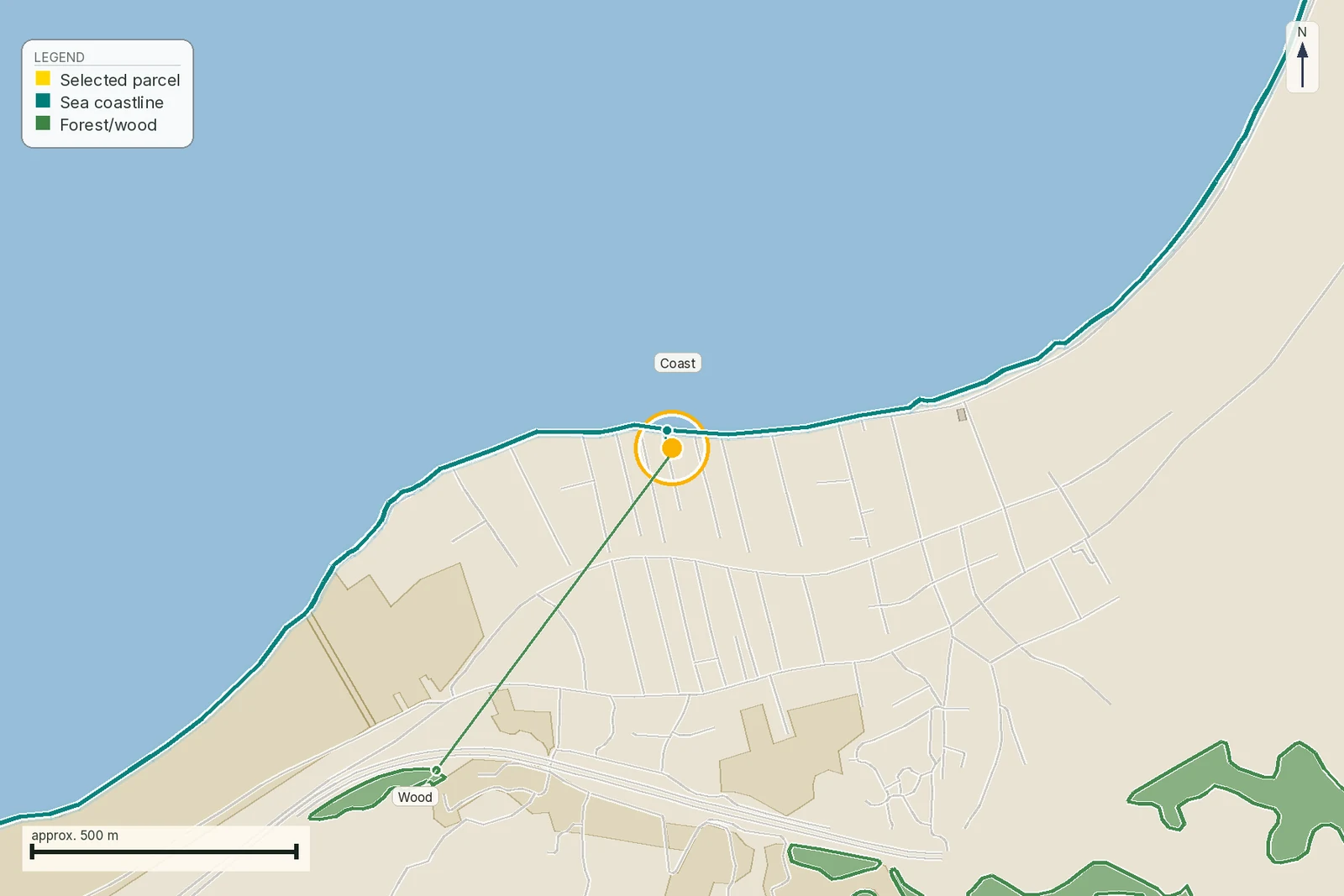
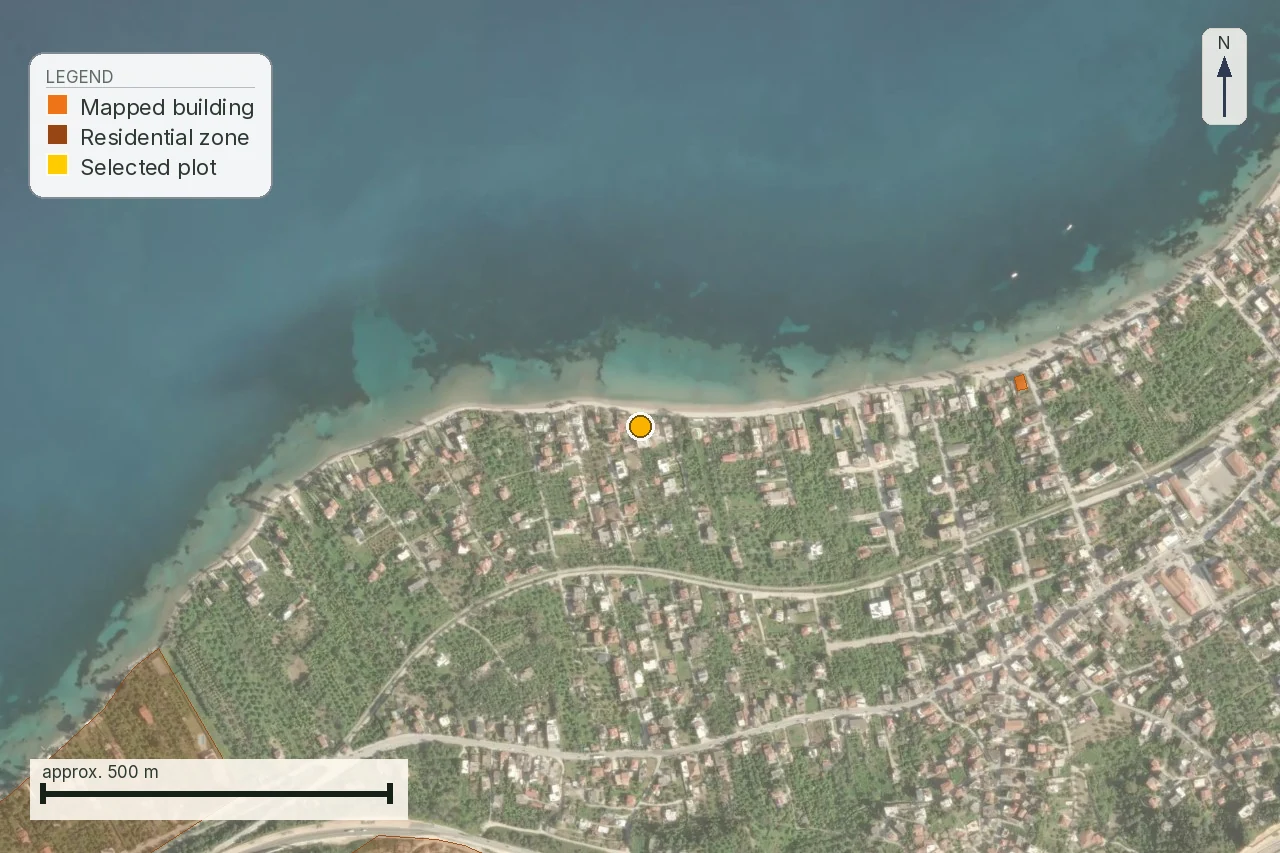
Check this on your own parcel
Pin the plot, confirm the KAEK, and every check in this guide is read against it and written up with its source and date. EUR 29 total · VAT included.