
Διαβάστε το άρθρο στα ελληνικά.
Electronic Building Identity: the Document That Gates a Greek Sale
On this page
No completeness certificate, no deed. The file behind it is where unauthorised square metres surface, and it belongs to the seller.
This guide is a preliminary screen for a cost or timing question, not legal, surveying, engineering or tax advice; read the full scope and limits before relying on it.
Have a specific plot in mind? Every check in this guide can be run on it, with source and date, for EUR 29 total · VAT included. Pin it on the map →
If a building stands on the land you are buying in Greece, one document decides whether the sale can be signed at all: the Ηλεκτρονική Ταυτότητα Κτιρίου, and the completeness certificate an engineer issues from it. No certificate, no deed. It is the seller's obligation and the buyer's problem, because the file behind it is where unauthorised square metres come to the surface. Read this beside the guide to unauthorised construction and the guide to verifying a building permit.
The pages that circulated in January 2026 warned about a deadline that has since moved. This one carries the current dates and separates the certificate, which is a formality, from the file, which is the part that changes a price.
What the building identity is
Ν. 4495/2017 built a single electronic record for every building and every autonomous property unit in the country. Its Κεφάλαιο Δεύτερο, running from άρθρο 52, gathers the permit, the drawings, the energy certificate, the declarations that legalised any unauthorised part and the plans of the building as it actually stands, and stores them under one identity held in a national register. Ν. 4759/2020 reshaped the provisions and the categories that follow from them. The Technical Chamber of Greece runs the platform through which an authorised engineer submits the file.
Two consequences follow for a purchase. The first is procedural. Since 1 April 2022 the completeness certificate has taken the place of the older engineer's certificate under άρθρο 83, so the notary now attaches this document when a building changes hands. The second is substantive. Filling the file obliges somebody to draw the building as it stands and set those plans beside the ones the authority approved. Where the two disagree, the disagreement has a name, a surface area and a cost.
The deadline that filled the news is no longer the deadline
Άρθρο 55 splits buildings into two categories. Κατηγορία Ι covers buildings that gather the public: state buildings, schools, hospitals, theatres, fuel stations, tourist accommodation above a size threshold. Those owners file by a fixed date. Κατηγορία ΙΙ covers everything else, homes and shops and offices included, and there the duty is triggered by the transfer rather than by a calendar.
The Κατηγορία Ι date became a news story because it fell on 31 January 2026 and thousands of owners were nowhere near ready. Then ν. 5270/2026 moved it to 1 February 2028, and moved the separate deadline for declaring unauthorised works from 31 March 2026 to 31 March 2028. Any advice still built on the January date is two years out. For a buyer of a house none of this was ever the operative rule: the sale is the trigger, and a sale has no extension.
| Deadline | What it said | What applies now | Who it reaches |
|---|---|---|---|
| Building identity, Category I | Expired 31 January 2026 | Extended to 1 February 2028 | Owners of buildings open to the public |
| Declaring unauthorised works | Expired 31 March 2026 | Extended to 31 March 2028 | Anyone with an undeclared part to regularise |
| Building identity at transfer | In force since 1 April 2022 | Unchanged, and triggered by an event instead of a date | Every seller and every buyer of a building |
Source: the Technical Chamber's notice on ν. 5270/2026, January 2026, read with άρθρο 55 ν. 4495/2017. Checked 16 August 2026. These deadlines have moved repeatedly, so confirm the current one before relying on any date.
The certificate is a formality; the file is the diligence
The Πιστοποιητικό Πληρότητας Ταυτότητας Κτιρίου is issued by the authorised engineer, carries a unique number from the electronic register and states the ΚΑΕΚ of the plot. Άρθρο 58 treats it as a public document and it is what gets attached to the deed. Read on its own it says one thing: the file has been completed. It does not say the building is lawful, and it does not say the buyer will like what the file contains.
So ask for the file, and specifically for two of its items side by side: the drawings that accompanied the permit, and the κατόψεις drawn to the building's real condition. Every closed-in balcony, every converted basement, every extra room under a pergola shows up as the difference between those two sheets. Where a legalisation declaration exists, ask which law it was filed under, what it covers and whether the payments are complete, because an incomplete declaration is a liability that travels with the property.
Two real buildings, and why the ratio matters before you read a page
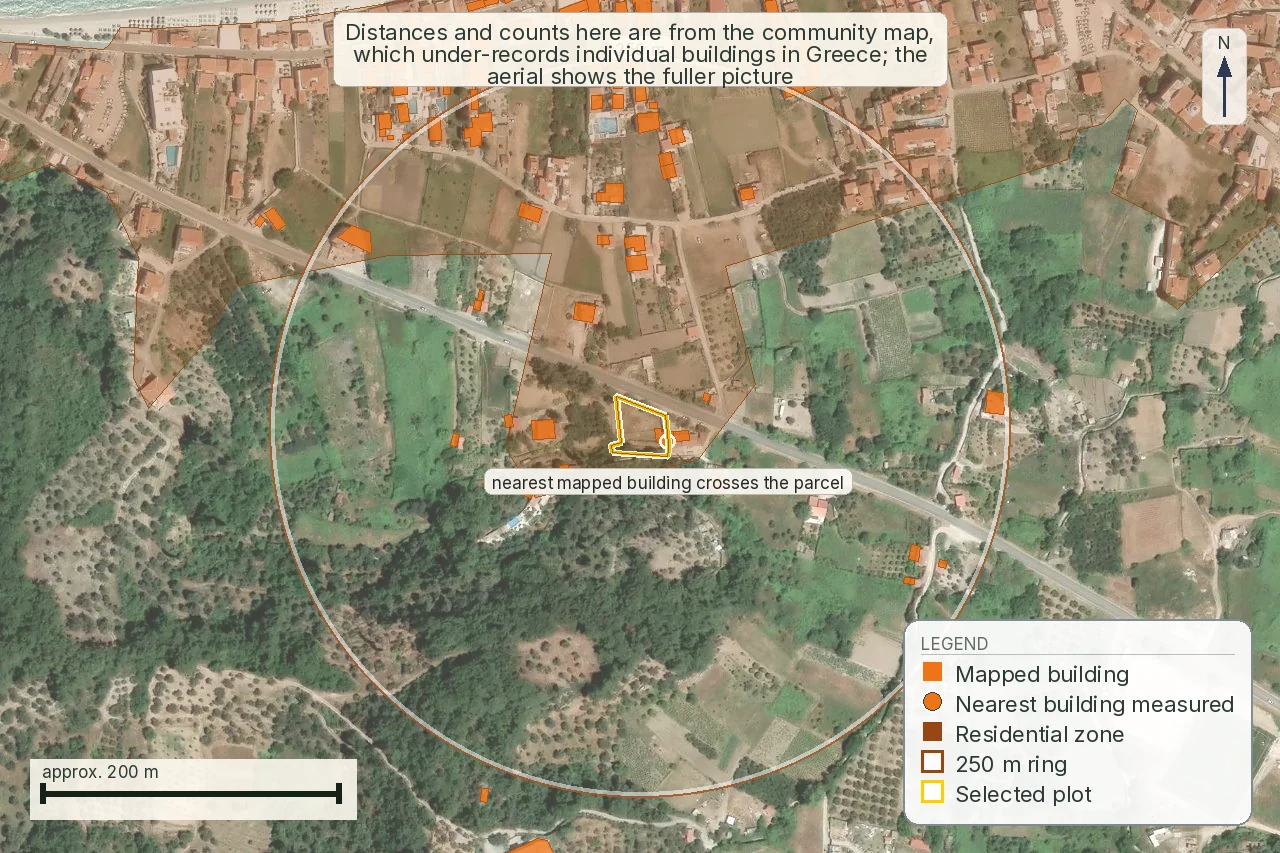
Take two coastal parcels this engine read on the same day. Above Kokkari on Samos, KAEK 430170242246 covers 1,084 m² and carries a mapped footprint of about 94 m². In Koroni, Messenia, KAEK 361230180008 covers 780 m² and carries a mapped footprint of about 737 m². The first is a small house with land around it. The second is a plot built out to its edges.
Before anyone opens a drawer, that ratio tells you how much work the identity file will be. A 94 m² house has one storey of plans to reconcile and obvious room for a lawful extension. A 737 m² structure filling its plot has far more surface where the approved drawings and the standing walls can have parted company over forty years, and very little room left to legalise anything by moving it. Ask both sellers the same question and expect the second file to take longer and cost more to put right.
One caution on the numbers themselves. Both footprints come from a community mapping layer that under-records buildings in Greece, which is why our own report prints that warning on the map. A footprint is a reason to ask for the identity file. It is never a substitute for one, and an empty map is no evidence that a plot is bare.
Fitting the engineer's work into your timetable
Compiling an identity file is slow when the paperwork is thin. The engineer has to recover the permit and its revisions from the planning office, survey the building, draw it, obtain an energy certificate and, where an unauthorised part exists, run a legalisation before the file can be completed at all. On an older house with a lost permit that is weeks of work, and it is the seller who must appoint the engineer, because the platform works from the owner's authority.
A buyer therefore has one practical lever and should use it early.
- Ask, before making an offer, whether an identity file already exists for this building.
- Write the certificate into the offer as a condition, with a date attached to it.
- Ask for the completed file, and read the as-built plans against the permit drawings.
- Check that the certificate names the ΚΑΕΚ of the plot you are actually buying.
- Where a legalisation is in progress, ask for its filing and its payment schedule.
A deposit paid against a thirty-day completion, on a house whose seller has not yet appointed an engineer, is a schedule nobody can keep. That is the single most common way this requirement turns into a lost deposit rather than a piece of paper.
Buying from abroad, when the file is not yours to commission
A buyer living outside Greece meets an awkward asymmetry here. The identity belongs to the owner, the engineer is appointed by the owner, and the buyer has no standing to order the work or to hurry it. What a buyer can do is make payment conditional on the certificate, and put somebody in Greece in a position to read the file when it lands.
Ask the lawyer to draft the πληρεξούσιο so that it covers receiving and reviewing the identity file, attending a site visit with an engineer of your own choosing, and raising objections about the as-built plans. A power of attorney written only for signing the deed leaves nobody able to read the drawings while there is still time to renegotiate. Ask that your own engineer, not the seller's, walks the building with the plans in hand.
What the certificate does not prove
An identity file describes a building. It says nothing about who owns it, where the plot boundary runs, whether the land is recorded as forest, whether a coastal line crosses it, or how much of the permitted envelope is left for a future extension. Those live in other registers with other keepers, and a buyer who reads a completeness certificate as a general clearance has confused one closed question with all the open ones.
The reverse error is just as expensive. A building with unauthorised parts is not unsellable; Greek practice has legalisation routes and a deadline that now runs to March 2028. What matters is that the extent is known before the price is agreed, in writing, with an engineer's figure attached. That is the whole purpose of insisting on the file rather than the certificate.
Where LandCheck fits, and where it stops
LandCheck runs before the engineer and before the lawyer. For one exact parcel it reads the cadastral outline, measures any mapped structure against it, dates every source and writes the building questions into the report as open items, alongside the forest, coastal, flood, planning and access checks the same parcel answers to. On both parcels above, the report already names the identity file among the documents to demand before a deposit.
What it cannot do is open the file. It does not verify a permit, confirm legality, price a legalisation or issue any certificate, and it is not legal or engineering advice. The report is a EUR 29 preflight from public data, built so that the first conversation with a Greek engineer starts from a written list instead of a blank page.
Common questions
Can a Greek property with a building be sold without an electronic building identity?
In the ordinary case no. Since 1 April 2022 the completeness certificate issued from the identity file is the document attached to the deed, and the notary needs it before the transfer can be drawn up.
Whose obligation is the building identity, the seller's or the buyer's?
The owner's, so in a sale it falls on the seller, who appoints the authorised engineer. The buyer's leverage is to make payment conditional on the certificate and to set a date for it.
Was the deadline of 31 January 2026 extended?
Yes. Ν. 5270/2026 moved the Κατηγορία Ι filing deadline to 1 February 2028 and the deadline for declaring unauthorised works to 31 March 2028.
Which buildings had to file by a fixed date rather than at sale?
Κατηγορία Ι under άρθρο 55: buildings that gather the public, such as state buildings, schools, hospitals, theatres, fuel stations and larger tourist accommodation.
What is inside the identity file?
Άρθρο 54 lists the permit and its revisions, the permit drawings, the energy certificate, any legalisation declarations, floor plans drawn to the building's real condition, and structural and shared-cost documents where they apply.
Does a completeness certificate mean the building is legal?
No. It certifies that the file has been completed. Legality is read from the permit, the as-built plans and any legalisation, which is why the file matters more than the certificate.
How long does it take to compile the file for an older house?
Weeks rather than days when the permit has to be recovered from the planning office, the building surveyed and drawn, and an unauthorised part legalised before the file can close.
What does the certificate not cover?
Ownership, the plot boundary, forest or coastal status, and the building rights left on the plot. Each of those is a separate register with a separate keeper.
Keep reading
Αυθαίρετα and τακτοποίηση: the unpermitted structure that voids a Greek deed
How to Verify a Greek Building Permit Before Buying a House
Buying land in Greece: the pre-purchase checklist, in the order the payments fall
What buying property in Greece costs: every line, with the provision behind it
Check this on your own parcel
Pin the plot, confirm the KAEK, and every check in this guide is read against it and written up with its source and date. EUR 29 total · VAT included.