
Pillar: Ground, hazard and utilities
Διαβάστε το άρθρο στα ελληνικά.
Septic tank or sewer in Greece: the wastewater question before buying
On this page
A Lefkada parcel that is out of plan, on a 28.6% slope, where the wastewater route affects the house design, its permit file and its operating cost.
This guide is a preliminary screen for a cost or timing question, not legal, surveying, engineering or tax advice; read the full scope and limits before relying on it.
Have a specific plot in mind? Every check in this guide can be run on it, with source and date, for EUR 29 total · VAT included. Pin it on the map →
The parcel in Poros, Lefkada, KAEK 340340402033, is where wastewater can decide whether a house is a project at all. It is out of plan, covers 41,307 m² and has a mean slope of 28.6%. The nearest mapped road is 10 m away, classified as a track. That proximity may make an approach look easy. It says nothing about a sewer connection, a tanker route or a lawful on-site discharge. Read the slope guide beside the buildability guide, then ask the municipality and engineer questions tied to this ground.
The Lefkada parcel begins with a wastewater route, not a fixture
A buyer does not purchase a toilet and add a disposal answer later. The house, its occupancy, its levels, its access and its receiving ground form one system. The parcel's 28.6% mean slope makes gravity, excavation, retaining works, pump chambers and tanker access part of the first feasibility conversation. The 10 m track is a useful map finding. It can help locate the approach. It cannot prove that the road is a common-use frontage, that a utility pipe reaches the boundary or that a service vehicle can reach a tank after construction.
The parcel is large enough to distract the eye. Area can help a designer search for a route, while it leaves the route unresolved. The proposed house may need a level platform. The wastewater system may need a different level. A tank that looks possible on a flat sketch may require deep excavation or a pump on this slope. The buyer needs a drawing and a written answer before a site price is treated as a house price.
Ask whether a network exists where the property can use it
The first call goes to the local water and sewer utility or the municipality identified for the property. Ask whether the house can connect, where the connection point is, what invert level and capacity are available, what extension work is required, who owns that work and which fees or approvals apply. Ask for the answer in writing, with the parcel identified by KAEK and a current survey.
A public map may show a served settlement, an agglomeration or an infrastructure line. The wastewater research keeps the limitation clear: a nearby sewer line does not prove a parcel connection. Distance to a settlement is a screening signal. A connection point at the boundary is a service answer. They belong in different fields in the purchase file.
| Evidence | Useful first question | Parcel answer still required |
|---|---|---|
| Served area or settlement | Which utility covers this locality? | Does it serve the parcel at the boundary? |
| Mapped pipe | Where is the actual connection point? | What level, capacity and terms apply? |
| Out-of-plan location | Which alternative route is recognised? | Can the engineer place it on the parcel's slope? |
If the utility says there is no network, ask whether that means no pipe in the road, no available capacity, no approved extension or no service obligation for this out-of-plan parcel. Those answers lead to different designs and negotiations. Keep the name of the officer, the protocol number, the date and the map or plan used. The buyer's question is not “is there a town nearby?” It is “what lawful route serves this house and who confirms it?”
Keep a sealed tank separate from a septic system
A sealed tank, commonly called a στεγανός βόθρος, stores wastewater for collection. It needs a watertight tank, a route for the tanker, a place where the vehicle can stand and a local arrangement for licensed emptying. It commits the owner to repeated service. Frequency depends on occupancy, tank volume and use. A holiday house and a permanent home can produce very different operating patterns, but both need access on the days a tanker is required.
A septic arrangement, commonly called a σηπτικός βόθρος in the programme vocabulary, adds treatment and disposal through the soil or another receiving arrangement. That makes percolation, groundwater, soil conditions and the receiving ground design facts. A tank lid in a garden cannot establish that the installation is approved, watertight, correctly sized or connected to a lawful endpoint. Existing drawings, approvals, maintenance records and pump-out receipts matter.
There may also be a compact treatment unit. It still needs a lawful discharge or reuse route, power, servicing and sludge removal. The label chosen in an advertisement is not the design. The engineer must state what the system is, where the liquid goes, how solids are removed and what access it needs. The buyer should price the whole route, including the service vehicle and the future operator, before comparing it with a public connection.
The law file is local before it is theoretical
The source register used for this guide includes YPEN material on urban wastewater, the gov.gr page for wastewater-treatment installations and YPEN environmental licensing material. Greece's national basis for cesspits is Υγειονομική Διάταξη Ε1β/221/1965 “Περί διαθέσεως λυμάτων και βιομηχανικών αποβλήτων” (ΦΕΚ Β΄ 138/24.2.1965), as amended. Its άρθρο 8 contains the table of special conditions by disposal method. This page does not print the individual distances because the text of άρθρο 8 was not opened. The instrument is applied locally by the health service (Διεύθυνση Υγείας) and ΥΔΟΜ. The limited repeal in ν. 4042/2012 concerns only wastes listed in the European Waste Catalogue, not domestic sewage. Ask the service and engineer which άρθρο 8 conditions the proposed or existing installation meets.
This boundary protects the buyer from a common false certainty. A generic distance remembered from another island may come from a different system, a different permit, a different environmental instrument or an older local decision. Ask the authority which instrument governs the parcel and ask the engineer to cite it in the plan. If an exact number is proposed, record its source and the feature from which it is measured.
The slope turns levels into a service question
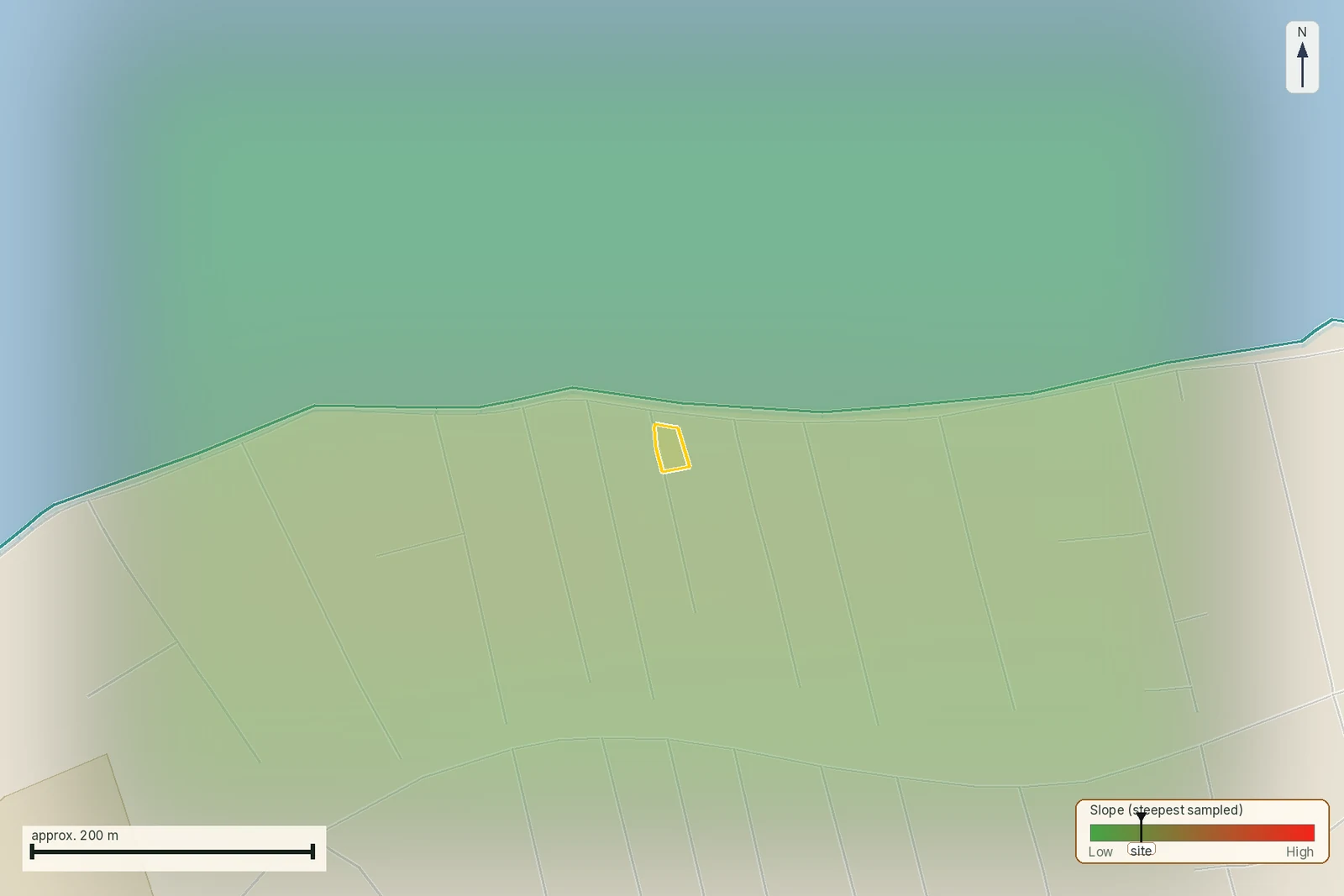
The parcel has a 28.6% mean slope. That is a screen across the parcel, not a construction section. The house footprint may sit on a gentler bench or cross a steeper strip. Pipes need continuous falls or pumping. A sealed tank needs a location that can be built, inspected and emptied. A septic arrangement needs enough soil and a receiving area that stays suitable through wet conditions. A compact unit needs power and room for maintenance.
Ask for contour lines, a longitudinal access section and cross-sections through the proposed building and wastewater components. Ask where runoff goes in a storm and how clean surface water is kept out of the wastewater system. Ask where a tanker stops and how a replacement or repair reaches the tank. Those are design facts. A mean-slope tile in a public report helps prioritise the questions; it cannot answer them.
Agios Arsenios, Naxos: the flat control, not a substitute parcel
The Agios Arsenios parcel on Naxos has a mean slope of 2.7%. It is a useful control for terrain, because a much flatter parcel makes gravity and construction access easier to examine. It does not transfer a sewer right to the Lefkada parcel, and it does not prove that the two parcels share a municipality, network, soil or environmental route. The comparison is intentionally narrow: terrain changes the wastewater design even when the legal question has the same name.
Use the flat control parcel to test the quality of an explanation. If a seller says “the septic solution is simple” without a section, ask whether simple means flat, accessible, approved or merely familiar. If an analyst uses the Lefkada parcel's area to dismiss the problem, put the slope and route back into the frame. The control helps expose a missing variable; it does not create evidence for the subject parcel.
What a public map can establish first
Public geography can help the buyer decide whom to call. It can show a served area, a settlement or a mapped infrastructure signal. It can locate the parcel, the track and the surrounding terrain. It can show environmental layers that may affect a disposal route. It can also show that the utility network is unpublished or that the layer carries no parcel-level connection attribute. Each result deserves its own wording.
Do not turn a straight-line distance into a pipe route. Do not turn a served polygon into capacity at the boundary. Do not turn a “no feature found” response into proof that no local network exists. The public read is valuable because it narrows the next request. It does not finish the request.
Make the utility answer measurable
Send the utility a small, unambiguous packet. Include the KAEK, a current topographic diagram, the intended use, an approximate building position and the road or mapped dirt road by which the property is reached. Ask for an answer that names the connection point, invert level, capacity, distance along the actual route, required extension, responsible party, fees and conditions. Ask whether a private pumping arrangement is accepted and who maintains the connection.
The request should also ask for a negative answer in a useful form. “No sewer” may mean that the service has not checked this parcel. Ask whether the parcel lies inside the network service area, outside it, or in an area with a planned extension. Ask what alternative the authority expects for an out-of-plan dwelling. The buyer can then give the engineer a public position to test against the ground.
Let the soil and groundwater choose the on-site route
When a public sewer is unavailable, the engineer studies the possible on-site routes. For a sealed tank, the focus is containment, structural placement, access and emptying. For a septic arrangement, the receiving soil, percolation, groundwater and separation from sensitive features matter. A compact treatment unit adds power, maintenance and a lawful endpoint. The site may permit one route, several routes with different costs, or no route that fits the proposed house without redesign.
The parcel's island slope adds drainage pressure. The designer must understand where surface water travels and where a tank, bed or outlet can sit without being undermined or made inaccessible. The research allows the buyer to ask about coastal, stream, Natura and groundwater constraints as possible reasons why a cheap disposal route disappears. It does not establish that one of those constraints affects the parcel. That is why the site review and the authority file remain necessary.
Existing installations create a document problem
If the seller points to an existing tank, ask for its drawings, approval documents, maintenance history, pump-out receipts and any alteration record. Ask the engineer to locate it on the current survey and to identify every pipe entering and leaving it. A lid proves physical presence. It does not prove the tank's volume, watertightness, legal status, service access or capacity for the buyer's intended occupancy.
Do the same for a claimed sewer connection. Ask where the private pipe begins, where it joins the public system, who accepted the connection and whether the house has an account or a service record. A house that has been used for years can still have an undocumented installation. Historical use is a reason to investigate the file, not a replacement for it.
The permit file must show the route from house to endpoint
Before a house is designed, the permit team needs to understand the wastewater choice. The drawings should show the building and expected use, pipe routes, levels, inspection points, tank or treatment components, access for service and the receiving ground or lawful discharge point. The engineer should identify the approvals and local terms that support the route. If the route crosses a stream corridor, coastal control, protected area or another sensitive layer, that interaction should be visible in the wider project file.
Do not let the wastewater page become a detached utilities paragraph. On this parcel it interacts with excavation, retaining, road access and drainage. The out-of-plan planning file also remains open: the large area does not by itself establish a right to build, and the track at 10 m does not by itself establish legal frontage. The house must first have a lawful planning route, then a wastewater design that fits the actual envelope.
Compare ten years, not just the first quote
A public sewer may require an extension, connection fee, pump or private route. A sealed tank requires repeated emptying, tanker access, maintenance and eventual replacement. A septic arrangement requires inspection, maintenance, sludge management and a receiving ground that remains suitable. A treatment unit requires energy, service visits, parts and a legal discharge or reuse route. The first construction estimate is only one line in the decision.
Ask the engineer and local provider to separate capital cost, recurring service, access works, electricity, pumping and contingency. Put a ten-year scenario beside the house construction estimate. For a remote or steep parcel, frequent tanker visits can change the economics of an apparently cheap purchase. The article does not assign a price because the research did not establish a parcel-specific tariff or a reliable universal cost. It gives the buyer the fields that need a local number.
The dated parcel finding
On 1 August 2026, the Hellenic Cadastre parcel record for Poros, Lefkada was read: KAEK 340340402033, 41,307 m², out of plan, 28.6% mean slope and a mapped road 10 m away classified as a track. The Agios Arsenios parcel on Naxos was read as the terrain control at 2.7%. On 4 August 2026, the wastewater source register and the project research note were checked. The established finding is that the Lefkada parcel is the steep, out-of-plan case where the wastewater route needs local confirmation and an engineer's design. The public material did not establish a sewer connection at the boundary or a municipality-specific obligation. The national instrument exists, but this page did not open άρθρο 8 or determine which of its conditions the parcel's installation meets.
This is an honest result. It does not say that this parcel cannot take a house. It says that the buyer cannot price the house as ready until the municipality or utility identifies the connection position or the lawful alternative, and the engineer proves that the chosen route fits levels, soil, groundwater, access and the permit file. The Naxos control helps explain the terrain contrast. It does not answer the Lefkada parcel's service question.
Questions for the municipality or utility
- Which municipality and local utility serve KAEK 340340402033?
- Is a public sewer physically present on the road or track serving the parcel?
- Can the parcel connect, and where are the connection point, invert level and available capacity?
- Is an extension planned, approved or merely discussed?
- Who pays for an extension, a pumping connection or work outside the network?
- What written terms and drawings must accompany an application for this out-of-plan house?
- If no network exists, which local authority receives the alternative design or environmental file?
- Which records exist for any claimed previous connection or on-site installation?
Questions for the engineer before the house is drawn
- Where do the contour sections place the house, tank, treatment unit and service access?
- Can the system work by gravity, or where are pumps, power and backup measures required?
- What soil, percolation and groundwater evidence supports a septic arrangement?
- Where does treated or stored wastewater lawfully end, and how is that endpoint maintained?
- Can a tanker reach the tank in all seasons without crossing land for which no right exists?
- What happens to the route during heavy rain on the 28.6% slope?
- Do the house, access, retaining works, stream and environmental layers fit on one survey?
- Which documents and approvals must be in the permit file before the buyer pays?
Close the wastewater gate in four written steps
The first step is a service answer. The second is a document answer. The third is a ground and design answer. The fourth is a financial answer that includes operation. If any step stays verbal, mark it as missing data. A buyer can continue investigating a gap. A buyer should not quietly turn it into a promise in the purchase price.
What the map does not confirm
A public map can identify a service signal and a route for further questions. It cannot prove a connection at the parcel boundary, available capacity, a right to cross the track, lawful disposal or approval of an existing tank. The record also cannot decide the local municipality, the final house position or the engineer's soil conclusion from the parcel's mean slope alone.
The same caution applies to a nearby septic installation. It may show what another owner built. It does not prove that the system is approved, that the soil is the same, that the groundwater level is the same or that the present owner's maintenance is adequate. The buyer's file should carry evidence for this parcel, with the source, date, geometry and limitation beside each finding.
Scope of this page
This page follows the parcel at KAEK 340340402033 in Poros, Lefkada, and uses the Agios Arsenios parcel on Naxos as a flat terrain control. It explains how a buyer asks about public sewer, sealed tank, septic arrangement and compact treatment, and how slope, access and permit documents change the decision. It does not certify a municipality, a sewer connection, a treatment approval, soil suitability, ownership or buildability. LandCheck is a property preflight report, not legal, environmental, surveying, architectural or engineering advice. Before signing or paying a deposit, obtain the local written answer and the opinion of the appropriate Greek engineer and lawyer.
Common questions
Does a sewer line near the parcel mean I can connect?
No. Ask the local utility or municipality for the connection point, invert level, available capacity, required extension and written terms tied to the KAEK.
What does a sealed tank commit the owner to?
It commits the owner to watertight storage, lawful emptying, tanker access, maintenance and recurring operating cost. The tank's presence does not prove its approval or capacity.
How is a septic arrangement different from a sealed tank?
A septic arrangement adds treatment and disposal through soil or another receiving route. Percolation, groundwater and the receiving ground become design evidence.
What does the 28.6% slope change for this parcel?
It makes levels, excavation, gravity or pumping, retaining works, surface drainage and tanker access early design questions. The mean slope is a screen, not a complete section.
Can the 10 m track solve the wastewater access?
It helps locate a mapped approach. It does not establish legal frontage, a common-use road, a pipe route or safe tanker access. Those points need separate evidence.
What should the municipality answer about an out-of-plan house?
It should identify the serving utility, network status, connection terms or alternative route, the responsible approval path and the records needed for the property-specific application.
Which drawings belong in the permit file?
The file should show the building, occupancy, pipes, levels, inspection points, tank or treatment parts, service access and lawful receiving ground or discharge route, with the supporting approvals.
Does the flat Naxos control's 2.7% slope prove the Lefkada parcel can use the same wastewater design?
No. It is only a flat terrain control. This parcel needs its own contours, soil, groundwater, access, authority answer and design.
How should I compare sewer and on-site costs?
Separate construction, extension, pumping, power, servicing, emptying, sludge removal and replacement. Put a ten-year operating scenario beside the first construction quote.
Keep reading
Check this on your own parcel
Pin the plot, confirm the KAEK, and every check in this guide is read against it and written up with its source and date. EUR 29 total · VAT included.