
Διαβάστε το άρθρο στα ελληνικά.
ATAK, KAEK and the building identity: the three Greek property numbers a buyer meets, and where to find each
On this page
ATAK, KAEK and the electronic building identity: three Greek property numbers, what each identifies, where to find it and which one a buyer needs.
This guide is a preliminary screen for a cost or timing question, not legal, surveying, engineering or tax advice; read the full scope and limits before relying on it.
Have a specific plot in mind? The map checks from this guide can be run on it, with source and date, for EUR 29 total · VAT included. Pin it on the map →
A Greek seller hands you a contract draft with a KAEK on page one, the accountant asks for the ATAK, and the engineer talks about the building's electronic identity. They are three different numbers held by three different systems. Mixing them up is the most common reason a foreign buyer's paperwork stalls in the week before signing. This guide sets them side by side and shows where each one lives.
Three numbers, three systems
| Number | Greek | Held by | What it identifies |
|---|---|---|---|
| KAEK | Κωδικός Αριθμός Εθνικού Κτηματολογίου | Hellenic Cadastre (Κτηματολόγιο) | A parcel of land (γεωτεμάχιο) and the rights registered on it |
| ATAK | Αριθμός Ταυτότητας Ακινήτου | Tax authority AADE, property register (Περιουσιολόγιο, form E9) | The property as declared by the owner for tax |
| Building identity (ΗΤΑΚ) | Ηλεκτρονική Ταυτότητα Κτιρίου | Engineer's filing in the state system | The building's legal status, certified by an engineer |
The KAEK answers "which piece of land, and who has rights over it". The ATAK answers "which entry in the owner's tax return". The building identity answers "is what stands there legal". A buyer needs all three, at different moments.
KAEK: the cadastre number
The KAEK is a 12-digit code that identifies a single parcel. The first two digits are the regional unit (12 is Attica in the commonly quoted example 12 134 67 02 008) and the last three are the parcel's serial number in its block. You find it in the cadastral extract, on the Cadastre's map viewer, and in any contract signed since the area joined the cadastre.
Our KAEK guide explains how to search the map by address or number, and what the cadastral record does and does not prove.
ATAK: the tax register number
The ATAK is the number the tax authority uses for each property line in the owner's E9 return (the declaration of real estate held). It matters to you as a buyer for one reason: the transfer tax declaration in the AADE's myPROPERTY application needs the ATAK of the property being sold. Press reports on the transfer process describe filings rejected because the ATAK was missing, and the seller first having to update the property in the tax register.
The owner finds it after logging in to Taxisnet: the AADE's E9 application has a service called "Εύρεση ΑΤΑΚ Ακινήτου" (find a property's ATAK), with the tax year chosen from the left-hand menu. You cannot look up someone else's ATAK; ask the seller or their accountant for it, together with the latest E9 printout.
How the two are being joined
Since October 2026 the tax authority has started linking the two systems. Under AADE decisions A.1201/2026 and A.1203/2026 (Government Gazette B 6051, 7 October 2026), the KAEK entered in a myPROPERTY transfer declaration, and in declarations for gifts and parental transfers, is carried over automatically into the parties' E9 returns. Press reports also describe a planned single property identity number; treat that as announced, not in force, until the AADE says otherwise.
For you this means: make sure the KAEK in the contract, the KAEK in the transfer declaration and the property described in the seller's E9 all point to the same thing. If the E9 lists a 120 m² house and the cadastre shows a 95 m² building on that KAEK, someone has to explain the difference before the notary does.
Building identity: the engineer's certificate
The electronic building identity is a separate filing by an engineer that records the building's legal status. It is not a number you look up but a document you ask for. Our guide to the electronic building identity covers when a sale needs it and what it certifies.
Which number when
| Moment | Number you need | From whom |
|---|---|---|
| First look at a listing | KAEK | Seller or agent; check it on the cadastre map |
| Before the preliminary agreement | KAEK, cadastral extract | Seller, lawyer |
| Transfer tax declaration | ATAK (and KAEK) | Seller's accountant in myPROPERTY |
| Contract | KAEK, building identity, tax clearance | Notary, engineer, accountant |
| After completion | Your own E9 line with the KAEK | Carried over automatically for transfers filed in myPROPERTY |
What can go wrong
- No KAEK yet. In areas where the cadastre is not complete, the property is identified by older references. Your lawyer then checks the title chain at the old land registry.
- KAEK and E9 describe different things. A seller who declared the house for tax but registered only the land in the cadastre, or the reverse, needs to correct one of them. See our guide to cadastre and deed mismatches.
- The seller cannot find the ATAK. It is in their Taxisnet account. If the property was never declared in E9, the accountant files the correction before the transfer.
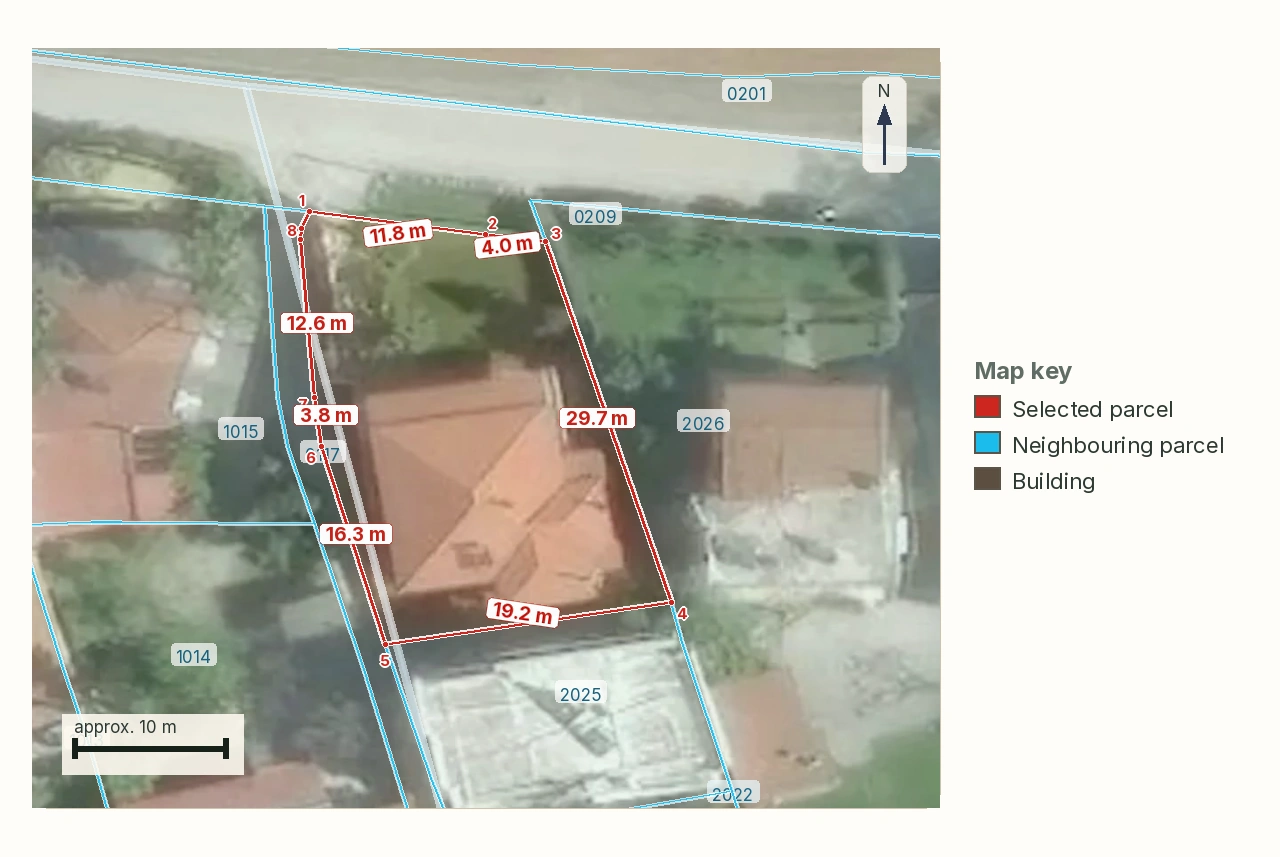
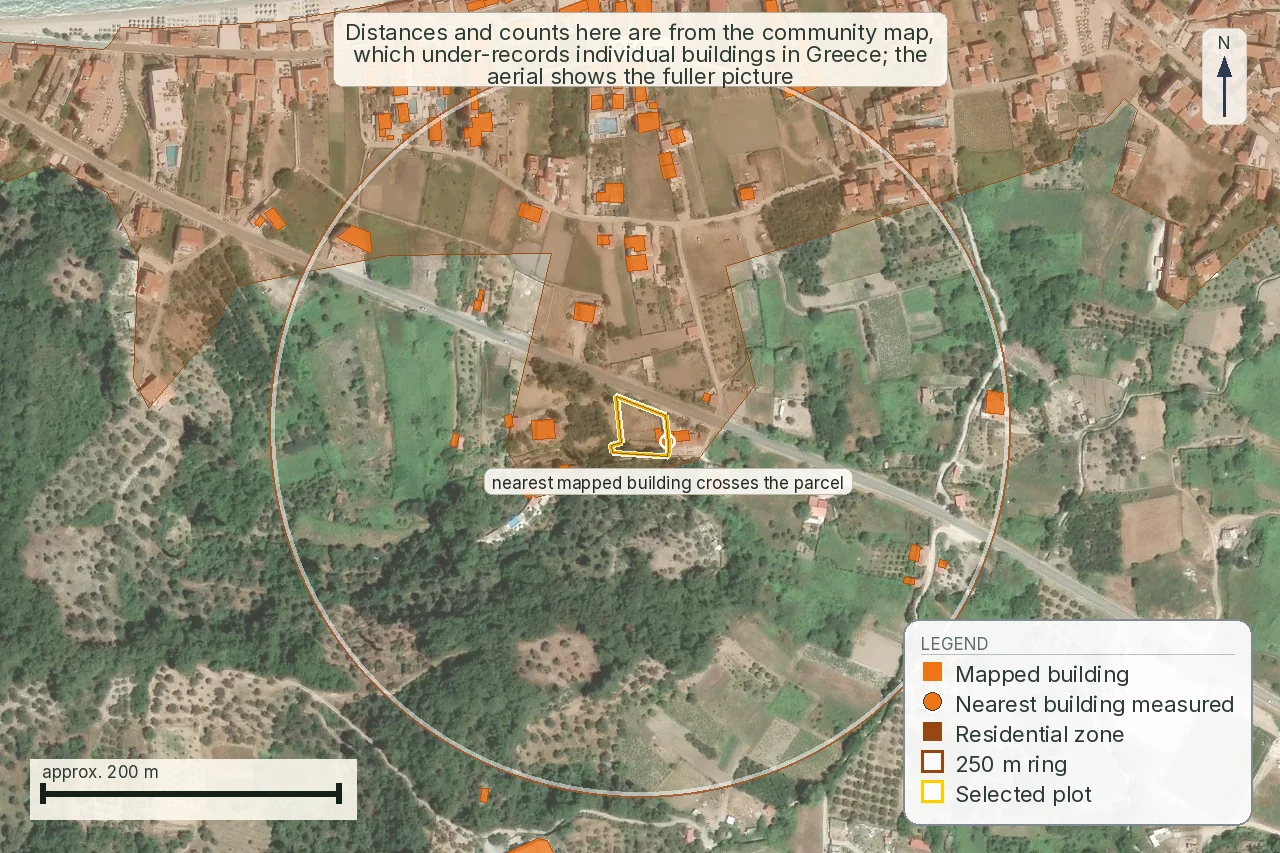
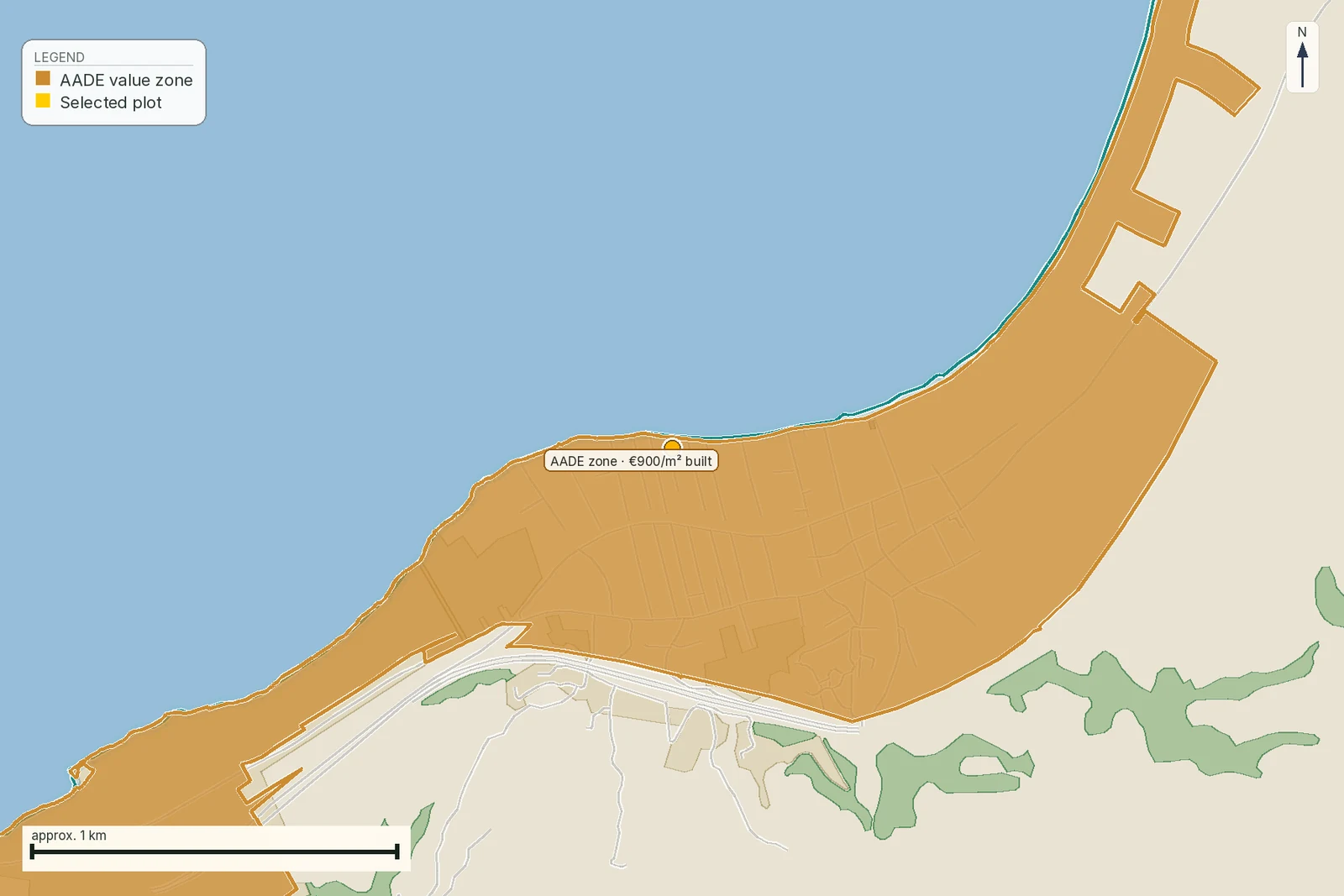
A LandCheck report starts from the KAEK: you pick the parcel on the map and get the cadastral outline, zoning, forest maps, coastal zone and risks, each with source and date. It does not read the seller's tax records. Check a parcel by KAEK in a LandCheck report → · Read a full sample report
Sources
- AADE, decision A.1201/2026 of 1.10.2026 (KAEK carried into E9 from myPROPERTY transfer declarations), aade.gr, and A.1203/2026, Government Gazette B 6051/7.10.2026, e-nomothesia.gr, accessed via search engine 2.11.2026.
- Finding the ATAK in the E9 application ("Εύρεση ΑΤΑΚ Ακινήτου"), taxrevenue.gr (secondary); ATAK required in the myPROPERTY transfer declaration, e-forologia.gr (secondary), accessed via search engine 2.11.2026.
- KAEK structure (12 digits, regional unit, serial number; example 12 134 67 02 008), Spitogatos, spitogatos.gr (secondary), accessed via search engine 2.11.2026.
- Planned single property identity number, newmoney.gr, newmoney.gr (press), accessed via search engine 2.11.2026.
Common questions
Is the ATAK the same as the KAEK?
No. The KAEK is the cadastre's parcel code; the ATAK is the tax authority's number for the owner's declared property.
Can I search the cadastre with an ATAK?
No. The cadastre map searches by KAEK or address. The ATAK lives in the owner's Taxisnet account.
Who gives me the seller's ATAK?
The seller or their accountant, from the seller's Taxisnet account. Ask for it together with the latest E9 printout.
Will I get a new ATAK after buying?
Your E9 will list the property you bought. For transfers filed in myPROPERTY since October 2026, the KAEK is carried into your E9 automatically.
Keep reading
ΚΑΕΚ and the Greek cadastre: reading the code, and the deadline behind it
Electronic Building Identity: the Document That Gates a Greek Sale
What buying property in Greece costs: every line, with the provision behind it
When a Greek deed and the cadastre disagree: who fixes the parcel?
Check this on your own parcel
A LandCheck report starts from the KAEK: you pick the parcel on the map and get the cadastral outline, zoning, forest maps, coastal zone and risks, each with source and date. It does not read the seller's tax records. EUR 29 total · VAT included.