
Διαβάστε το άρθρο στα ελληνικά.
Greek objective value versus asking price: keep the numbers separate
On this page
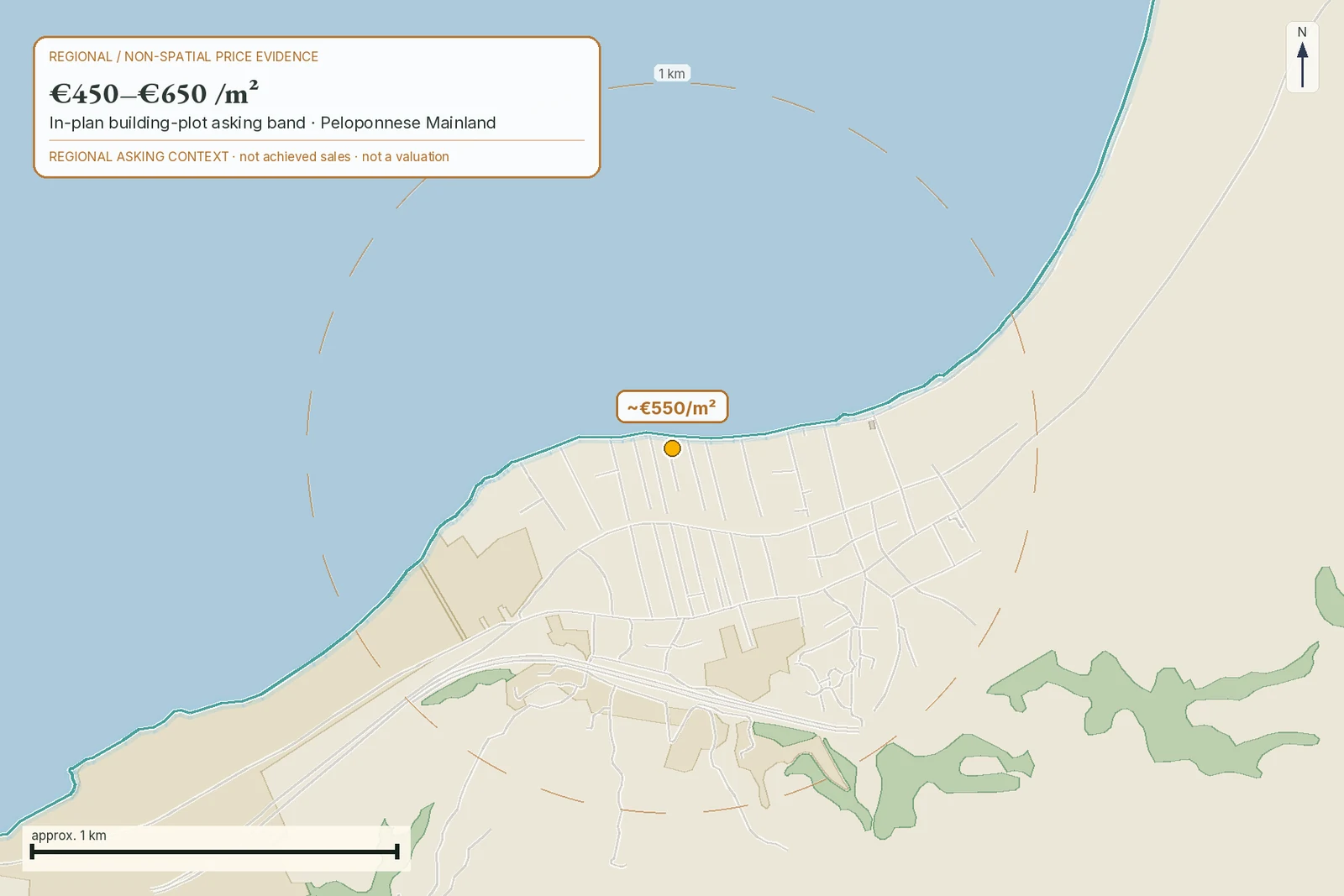
APAA, asking price and transfer observations serve different purposes. A buyer should not turn one into another.
This guide is a preliminary screen for a cost or timing question, not legal, surveying, engineering or tax advice; read the full scope and limits before relying on it.
Have a specific plot in mind? Every check in this guide can be run on it, with source and date, for EUR 29 total · VAT included. Pin it on the map →
The three numbers that most often get mixed together in a Greek listing are the APAA objective value, the seller’s asking price and an observed transaction figure. They answer different questions. The purchase-cost guide uses the tax and fee consequences as its own subject; this page stays with evidence design: what each number is, what it can support, and what it must not be made to say.
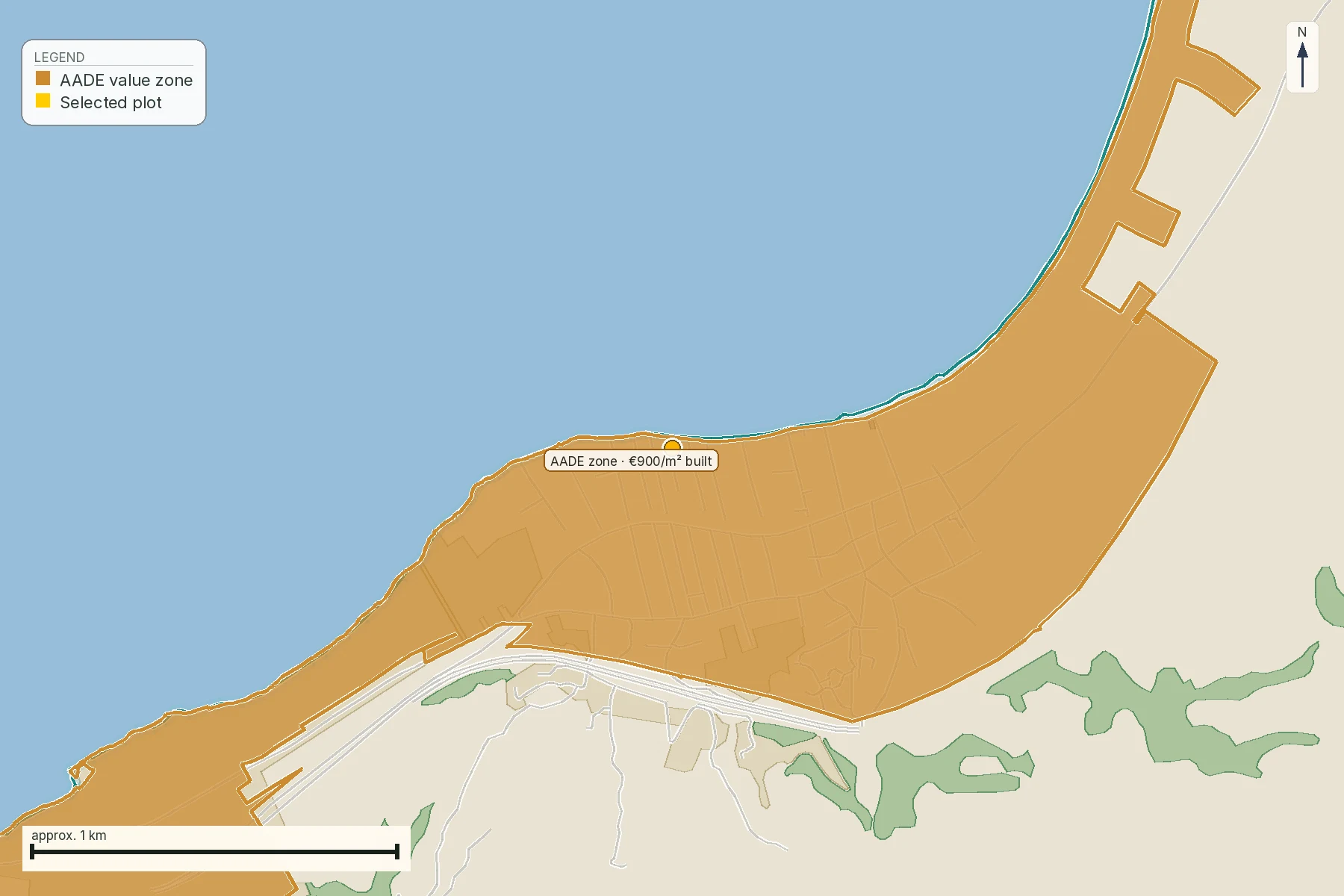
The official valuemaps service lets a user locate the property’s objective-value zone and calculate an APAA result from the relevant characteristics. Use it as a traceable tax-system input: record the zone, the form or parameters, the source version and the date. It answers a public-system question. The negotiation question is different, because a buyer and seller price a particular asset with its access, condition, title, timing and alternatives. Keeping those ledgers separate is more useful than forcing them into one percentage.
The Ministry of Finance also publishes the anonymous Property Transfer Values Register, which is designed to help users observe the formation of the property market. That makes it a different evidence family again: it concerns reported transfers. A seller’s current advertisement is a separate record. An asking price can be aspirational, stale, strategically high, or lower because the property has an urgent or complicated condition. The buyer must preserve the distinction. Averaging the numbers into a false “true price” erases it.
Why objective value is not market price
The APAA system is built around a formal method. It identifies the relevant zone, exposes digitised system elements and allows a calculation across the required forms. The official description is useful precisely because it tells us what the service is for: locating the zone and calculating objective value using the system’s parameters. It does not promise that the output captures every feature a buyer would price, such as a view, legal access, a difficult slope, an unregistered extension, a lease, a title problem or the urgency of the seller.
“Objective” describes the system’s method here. It is not a claim that the result is the one objectively correct market price. A rural field, an urban plot and a completed house can require different inputs and forms. The result must be labelled with the form, property type, date and assumptions used. A naked euro figure is not reproducible evidence.
The buyer should also avoid using APAA to infer buildability. The map may place a point in a zone and the calculator may return a result, but neither establishes the planning status, title, road frontage or permitted use. Those gates belong to the property file and the competent professional. The correct internal link is the buildability article. It does not lead to a valuation conclusion.
What an asking price actually tells you
An asking price is a communication by the seller or agent. It is evidence of a request at a particular time. It is not proof that a buyer will pay it. The listing may include a rounded number, a price copied from an earlier advert, a negotiation buffer, a conversion from another currency, or a price that assumes documents and access will be accepted without challenge. Preserve the original wording, date, currency and stated area.
For a foreign buyer, asking price can also hide scope differences. “Land” may mean a parcel with a clear road connection, an agricultural field reached by a track, or a parcel whose boundary still needs a survey. “Buildable” may be only a marketing adjective, well short of a written planning conclusion. A price-per-square-metre calculation is meaningless until the numerator and denominator refer to the same object.
Do not punish the listing for being an asking price; use it honestly. It tells you what must be negotiated and what claim the seller is making. Ask what documents support the price, whether the area comes from a title or survey, and whether the number changes if a condition fails. The answer becomes part of the buyer’s evidence file.
When Greek land changes hands without a sale
Asking price assumes a seller. A large share of Greek land changes hands without one, through a parental gift (γονική παροχή), a straight gift (δωρεά) or an inheritance (κληρονομιά), and there the “asking price” column stays empty. The taxable base still rests on the same APAA objective value this page has been explaining throughout; the tax scale applied on top of it is a separate matter entirely. A foreign buyer meets this route often, and sometimes more often than a Greek one does: family land bought from abroad routinely passes through a gift or an inheritance before it ever reaches a listing.
The Property Taxation Code (law 5219/2025, Government Gazette A’ 130 of 18 July 2025) sorts beneficiaries into three kinship categories: category A covers a spouse, children, parents and grandchildren; category B covers more distant relatives; category C covers everyone else (article 78). On an inheritance, category A gets a tax-free allowance of €150,000, then pays 1% up to €300,000, 5% up to €600,000 and 10% above that; category B starts at €30,000 with a top rate of 20%; category C starts at €6,000 with a top rate of 40% (article 79). On a parental gift or a straight gift, category A instead gets a single tax-free allowance of €800,000 and then a flat 10% rate (article 98): a far more generous allowance, though without inheritance’s lower graduated bands underneath it.
Cadastre registration fees follow the same split. A sale pays a base rate of 5‰ of the price. A parental gift or a straight gift pays a base rate of 8‰. We confirmed both of those base rates. An additional 1‰ surcharge that several summaries add on top of each rate, arriving at 6‰ and 9‰, we could not find in a primary text after checking multiple sources, so it is not printed here as settled. For accepting an inheritance the rate did not turn up in any source we checked at all; until it is confirmed, ask the Cadastre Office before pricing the registration.
A first-home exemption also exists for a parental gift and a straight gift, at the same limits as a purchase: €200,000 or €250,000 for a house, €50,000 or €100,000 for a plot, with an addition per child. One condition attached to it does not apply to a purchase: if the beneficiary or their spouse has sold another property that covered their housing need, the exemption is lost until five years have passed since that sale (article 96, paragraph 2). None of this is a step-by-step route through a Greek notary’s office; a local lawyer and notary handle that part. It is the cost exposure a foreign buyer needs on the table before assuming that a Greek family transfer prices out the same way a purchase would.
What the transfer register can add
The official transfer-value register is valuable because it points toward observed market activity while protecting the anonymity of the parties. It should be read as a source with coverage, filtering and timing limits. A group of observations can show that prices in an area are not all the same; it cannot prove that an anonymous record is comparable to the target parcel without checking property type, location, size, condition, rights and date.
Compare like with like. A flat in a serviced building is not a rural plot. A completed house is not a parcel with a planning uncertainty. A transaction concluded after a title correction is not automatically comparable to a listing before the correction. The public register can support a question for a valuer; it does not remove the valuer’s comparability analysis.
Keep the sample size and selection visible. If the service returns no observations for the chosen search, write “no matching public observations retrieved”. Do not write “the market is zero”, since that is a different, unverified claim. If it returns a wide range, do not use the midpoint as a valuation without explaining why. The missing-data checklist should identify the comparables the professional still needs.
Land, house and apartment require different inputs
A property’s category changes the meaning of every €/m² calculation. For land, use the legal and measured area separately until the survey and title agree. For a house, distinguish plot area, gross built area, usable area and the condition of the building. For an apartment, identify the unit, common areas, floor, age, energy and legal status. A listing that combines “large plot” and “renovated house” cannot be priced by one undifferentiated number.
APAA forms and coefficients also depend on property characteristics. The official material says that the objective system uses different forms and parameters. That is why a report should never copy a single zone price into every property type. It should record which output was requested, which inputs were entered and whether the target property falls inside the system’s intended coverage.
When a property sits at a boundary or partly outside the objective-value system, pause. Do not invent a blended number. Ask the notary or tax professional which method applies to the exact property and which official documents establish the taxable base.
| NUMBER IN THE FILE | USEFUL QUESTION | DO NOT INFER |
|---|---|---|
| APAA output | Which form and inputs produced it? | That it is market value |
| Asking price | What documents and assumptions support it? | That it will be achieved |
| Transfer observation | Is the property actually comparable? | That it proves this parcel’s value |
| €/m² | Which area and property type are used? | That the denominator is correct |
Use APAA to audit a number. Do not use it to manufacture one
When a seller gives an APAA figure, ask whether it is a current output for the same property category and whether the inputs are available. If the figure comes from an old document, label its date. If the target is an out-of-plan rural parcel, do not silently reuse a nearby urban zone price. If the value is used for a tax discussion, send the original form to the notary or tax professional.
When an agent says “the asking price is only slightly above objective value”, ask what that comparison means. It may be a tax-planning observation, a negotiation statement or an attempt to give a market impression. None is automatically wrong, but each needs a different source. A report should quote the claim and label it as a claim. It should not endorse it.
For the buyer, the useful output is a reconciliation card: target asking price, source and date; APAA output, form and date; any transfer observations, search and date; area and property type; and open comparability questions. That card is legible to a lawyer, notary or valuer and does not pretend that the report has performed a valuation.
Beware the €/m² shortcut
Dividing price by area is arithmetic. Analysis still needs comparable evidence. The number can change dramatically when the area changes from title area to survey area, when built and unbuilt space are mixed, or when a parcel has a different planning status from its neighbour. The same asking price may look cheap or expensive depending on which denominator the listing selected.
Make the denominator explicit and keep alternatives separate. “Asking price per advertised land area” is one metric. “Asking price per verified surveyed area” is another. Neither is a market value. If the survey is missing, the report should show the gap. Do not choose the denominator that makes the listing look better.
The buyer should also resist comparing a buildable plot with agricultural land, or a house with a legal extension with a house whose area is unverified. Planning, access, utilities, slope and title are not cosmetic adjustments; they can define whether the physical area has the use the buyer is pricing.
Buyer workflow before negotiation
Step one: preserve the listing exactly as seen, including date, currency, advertised area and every statement about zoning, access or documents. Step two: identify the property independently and collect the title or survey area. Step three: locate the objective-value zone and save the APAA result with its form, inputs and date. Step four: check whether the official transfer register has comparable observations, without claiming that an empty result proves anything.
Step five: classify each difference: source difference, time difference, area difference, property-type difference, condition difference or legal/planning difference. Step six: send the reconciliation to the buyer’s notary, lawyer or valuer. Step seven: negotiate only after the decision-critical documents are named. The asking price is a starting position; the report should not convert it into a recommendation.
For a plot, add the cadastre/KAEK article and the land-use article. For a house, add the file of permits and condition. For a foreign buyer, use the language workflow so that a translated number is not mistaken for a translated legal conclusion.
Decision gates before you pay a deposit
Gate one: the priced object is identified. Gate two: the area and property type used in every comparison are named. Gate three: the APAA output is dated and labelled as an objective-system result. Gate four: any market comparison states whether it is an asking price, an anonymous transfer observation or a professional appraisal. Gate five: the contract and tax treatment are referred to the right professional.
Pause if the seller refuses the source documents, if the advertised area is materially different without explanation, if APAA is being presented as market price, or if a single nearby transaction is being used as proof. Pause also when the property’s planning or title status changes the object being priced. A cheap-looking number can be expensive if it buys a different legal or physical object.
Proceed to a professional valuation or negotiation when the evidence is coherent enough to define the assignment. A valuer needs a subject, purpose, date, assumptions and comparable evidence. A notary needs the transaction and tax file. A lawyer needs title and contractual facts. LandCheck can prepare the handoff; it cannot perform those professional roles.
How to write the report conclusion
A sound conclusion might say: “The APAA output is a dated result of the state objective-value system. The listing figure is an asking price supplied by the seller. Public transfer observations, if available, are not treated as direct comparables without property-level review. The report does not estimate market value.” That is not evasive; it is the exact boundary of the evidence.
A poor conclusion says “the property is worth €X” because a zone value or listing number was available. Another poor conclusion says “the seller is overpricing” because one anonymous transaction is lower. Both conclusions skip purpose, date, comparability and professional scope. A buyer deserves a handoff that can be checked. A confident-sounding number is not that.
If a valuer is engaged, preserve the LandCheck source trail and ask the valuer to state which inputs they accepted and which they rejected. If the tax question is the issue, send the APAA form and property documents to the notary or tax professional. If negotiation is the issue, use the evidence as questions and conditions. It is not a guarantee of a discount.
What the numbers do not confirm
APAA does not confirm market value, saleability, title, planning permission, buildability, road access, utility connection, condition, rental income or future appreciation. An asking price does not confirm a buyer, a fair price, a clear title, the advertised area or the seller’s statements. A transfer-register observation does not confirm that the target property is comparable, nor does an empty search prove there were no sales.
None of these figures confirms ownership, encumbrances, construction legality, environmental restrictions or investment return. None replaces the official property documents or the professional who is responsible for the relevant opinion. A calculator is not a valuation report and a listing is not a transaction.
Where inputs are missing, keep the missing state visible. “APAA calculation not reproducible because property category is unknown” is more useful than a guessed number. “No comparable transfer observations retrieved” is more accurate than “no market”. Evidence design is strongest when it refuses to close a gap with arithmetic.
Missing-data checklist
- Listing snapshot with date, currency, advertised area and seller claims.
- Title and current survey area, kept as separate fields.
- Property type, use, age, condition and planning status.
- APAA zone, form, inputs, output and calculation date.
- Search parameters and date for the anonymous transfer register.
- Reason each selected observation is or is not comparable.
- Documents affecting title, access, utilities or buildability.
- Professional assignment: tax, negotiation or formal valuation.
Questions for the buyer’s professionals
- Notary: which APAA form and property inputs apply to this exact transaction?
- Notary: is the property inside the relevant objective-value system and how is the taxable base established?
- Lawyer: do title, survey, planning description and listing refer to the same object?
- Valuer: which comparable evidence is suitable and what adjustments are justified?
- Valuer: what is the valuation date and purpose?
- Engineer: does the advertised area or use depend on a buildability assumption?
- Buyer: which missing document could change the price or the decision to continue?
- Buyer: when should every number be refreshed before signing?
Final buyer workflow
Save first, calculate second, compare third, negotiate last. Saving protects the original claim. Calculating records the APAA method. Comparing forces the buyer to describe property type, area, time and purpose. Negotiating after those steps means the buyer can ask for a document, a condition or a professional review instead of arguing over an unexplained percentage.
For a remote purchase, send the same evidence pack to the Greek professional and keep the original Greek labels beside the English explanation. Do not translate “objective value” into “market value” for convenience. Do not translate “asking price” into “value”. The vocabulary is part of the protection.
The responsible conclusion is often conditional: the numbers are internally reconciled enough to commission a valuation or tax review, or they are not. If they are not, stop before the deposit and name the missing document. A report that leaves the buyer with a precise next question is doing its job.
| HANDOFF ITEM | WHY IT MATTERS | OWNER |
|---|---|---|
| Original listing | Preserves the claim | Buyer |
| APAA output | Preserves the method | Notary/tax professional |
| Comparable sample | Supports a valuation assignment | Valuer |
| Title/planning file | Defines the object | Lawyer/engineer |
A gap between the numbers is not itself a red flag. It can be entirely normal, because the numbers serve a different purpose. The red flag is using one as proof of the other: APAA presented as “market price”, a listing treated as a valuation, or a single anonymous transfer treated as certainty about the plot.
Keep the access date and the date of every figure on file. Zone values, characteristics and listings can all change. A report that does not keep time cannot explain why the same search returned a different result later.
Sound negotiation does not need false precision. It can say plainly: “The listing asks X, APAA gives Y as the system’s output, but the area and comparability still need checking. Before a deposit I am asking for documents Z.” That is a clean position, reached without an arbitrary discount.
The point of a preflight check is not to replace a valuer or a tax professional. It is to stop a buyer paying while different numbers are being presented as though they were the same thing.
Common questions
Is APAA objective value the market value?
No. It is an output of the state objective-value system. It should not be presented as a live market valuation.
Is an asking price evidence of what the property is worth?
It is evidence of what the seller asks at a date. It is not proof that a buyer will pay it or that the advertised property facts are correct.
What is the Property Transfer Values Register?
It is an official service for observing the anonymous formation of the property market. Its records still need comparability review.
Can I use APAA to prove a plot is buildable?
No. Value-system inputs do not confirm planning status, title, road frontage or permitted use.
Can I divide the asking price by the advertised area?
You can calculate that listing metric, but you must label the denominator and never call the result market value without professional analysis.
What if the APAA zone is unknown?
Do not guess from a neighbouring zone. Record the missing input and ask the notary or tax professional which official method applies.
Should a price discrepancy stop the purchase?
Not automatically. It should stop the buyer from paying until the object, area, purpose and professional question are clear.
Who should give a formal valuation?
A qualified valuer with a defined subject, purpose, date, assumptions and comparable evidence. LandCheck prepares the handoff only.
Keep reading
What buying property in Greece costs: every line, with the provision behind it
Buying land in Greece: the pre-purchase checklist, in the order the payments fall
ΚΑΕΚ and the Greek cadastre: reading the code, and the deadline behind it
What makes a Greek plot buildable: άρτιο, οικοδομήσιμο and the 4,000 m² rule
Check this on your own parcel
Pin the plot, confirm the KAEK, and every check in this guide is read against it and written up with its source and date. EUR 29 total · VAT included.