
Διαβάστε το άρθρο στα ελληνικά.
Out-of-plan land in Greece after Law 5306/2026: when a plot is buildable and how many square metres of house it allows
On this page
How much house you can build on out-of-plan land in Greece under Law 5306/2026: 4,000 m², 25 m frontage, 186 m² and the formula for larger plots.
This guide is a preliminary screen for a purchase or permit question, not legal, surveying, engineering or tax advice; read the full scope and limits before relying on it.
Have a specific plot in mind? The map checks from this guide can be run on it, with source and date, for EUR 29 total · VAT included. Pin it on the map →
A large share of the land sold to foreign buyers in Greece is out-of-plan (εκτός σχεδίου): outside any approved town plan and outside the limits of a delimited village. Olive groves, hillside plots with a sea view, fields at the edge of an island village. On 8 June 2026 Greece published Law 5306/2026 (Government Gazette A 88), which ratifies the Spatial Planning and Urban Code named after Nikolaos Tagaras. The Code brings the out-of-plan building rules, scattered for decades across laws and decrees, into one text with new article numbers.
For a buyer the questions stay the same. Can a house be built on this plot? If so, how large? This guide answers both from the Code, with worked numbers, and lists what an engineer still has to confirm.
First question: does the plot meet the minimum?
Article 251 of the Code sets the general rule for out-of-plan building: a minimum plot of 4,000 m² (four stremmata, the Greek land unit of 1,000 m²) with 25 m of frontage on a public road (κοινόχρηστος δρόμος). The frontage requirement does not apply, under conditions, to certain buildings covered by articles 252 and 253.
Two points catch foreign buyers out.
Frontage means frontage on a public road. A dirt track everyone drives on is not necessarily a public road in the legal sense. Documents tabled in the Greek Parliament note that the Council of State (ΣτΕ, Greece's supreme administrative court) has required the road to be a recognised one. A plot with 40 m along a farm track can fail this test. Ask your engineer to state in writing what kind of road it is and on what document that conclusion rests.
Smaller plots are not automatically unbuildable, and not automatically buildable either. For years, plots under 4,000 m² were built on through exceptions (παρεκκλίσεις) tied to the date the plot was created. Law 5317/2026 deals with these building exceptions and extends planning deadlines. If the plot is under 4,000 m², the listing's "buildable" is a claim to check: ask the engineer which exception the plot relies on, what document proves the plot's creation date, and how long the exception remains valid.
Second question: how many square metres of house?
Article 256 of the Code, which refers back to article 251 for the general conditions, gives a specific rule for houses on plots of 4,000 to 8,000 m². On the first 4,000 m² the house may not exceed 186 m². For the remaining area, add that area multiplied by 0.018.
| Plot area | Calculation | Maximum house area |
|---|---|---|
| 4,000 m² | 186 | 186 m² |
| 5,000 m² | 186 + (1,000 × 0.018) = 186 + 18 | 204 m² |
| 6,000 m² | 186 + (2,000 × 0.018) = 186 + 36 | 222 m² |
| 7,500 m² | 186 + (3,500 × 0.018) = 186 + 63 | 249 m² |
| 8,000 m² | 186 + (4,000 × 0.018) = 186 + 72 | 258 m² |
The numbers grow slowly. Going from four to six stremmata adds 36 m² of house, roughly one large bedroom and a bathroom. Doubling the plot from 4,000 to 8,000 m² adds 72 m².
That makes listings easy to test. A 5,000 m² plot advertised with "permission for a 300 m² villa" does not add up for a house under article 256: the formula gives 204 m². There may be an explanation (an older permit, a different use, a plot that is really larger), but the seller has to show it on paper.
Plots above 8,000 m² and uses other than housing follow other rules of the Code. Your engineer runs the calculation for the specific plot and the use you have in mind.
What the Code does and does not change for a buyer
The Code is a ratification: it gathers existing provisions into one text and renumbers them. In practice this means:
- Engineers' opinions, permits and contracts drafted after June 2026 cite new article numbers. An older opinion citing the previous laws is not wrong for that reason, but ask for one that names the Code article it applies.
- Article 438 contains the transitional provisions. If a permit application or a deadline was running when the Code came in, the engineer has to say which regime governs it.
- Village plots follow different rules. If the seller says the plot is "inside the village", read our guide to in-plan vs out-of-plan land first.
The other filters
A 4,000 m² plot with 25 m on a public road can still be unbuildable, or buildable only in part, if:
- it is forest land on the forest map (codes ΔΔ, ΔΑ, ΑΝ); see our guide to the forest map,
- it falls in the foreshore zone (αιγιαλός) or within the setback from a stream,
- it lies in an archaeological site or protection zone,
- it lies in an area with a special decree (ΖΟΕ, a land-use control zone) that sets stricter terms, which is common on islands and coasts.
Each of these can cut the buildable area below 4,000 m², and then the article 256 calculation starts from the wrong number.
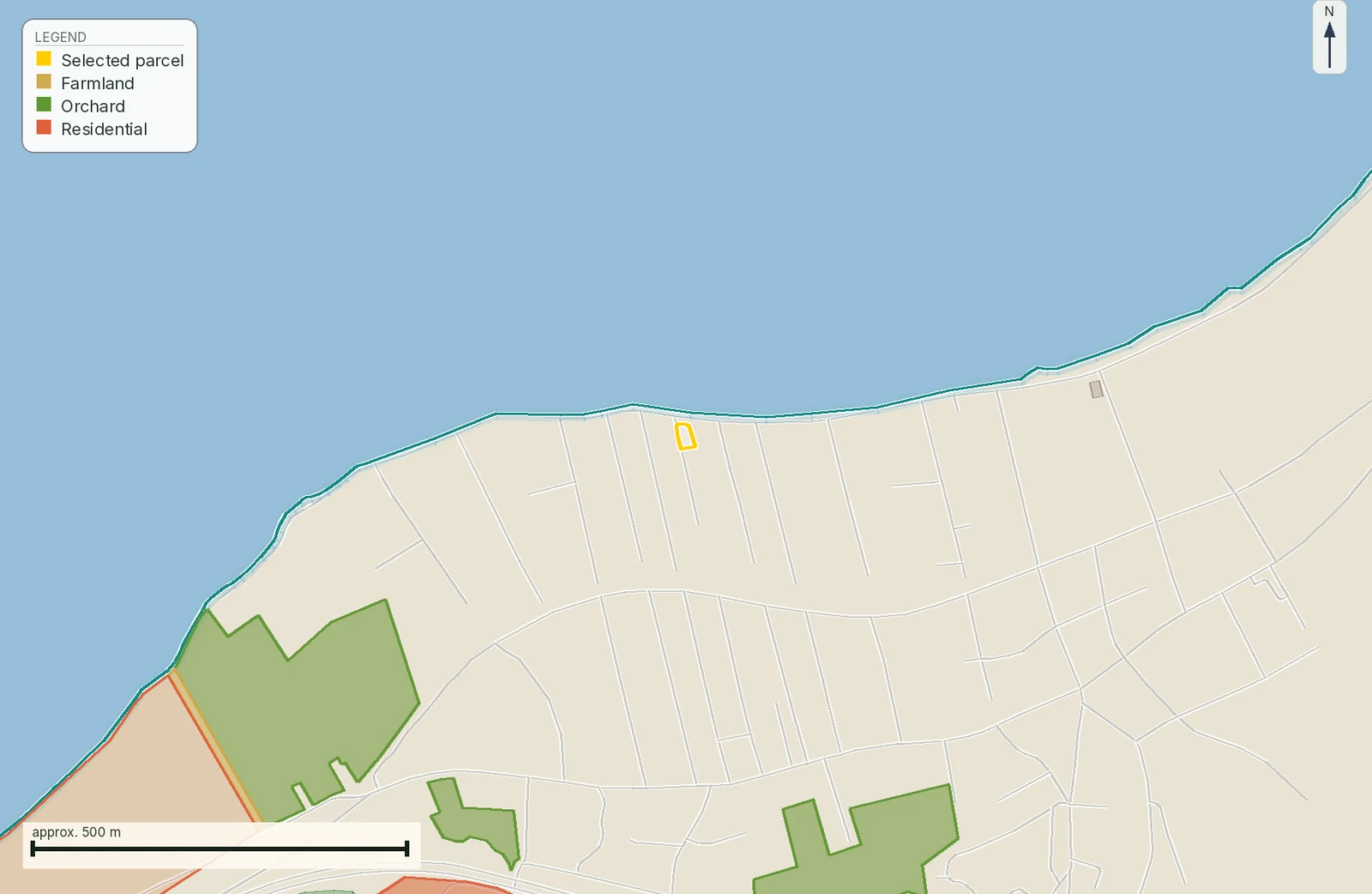
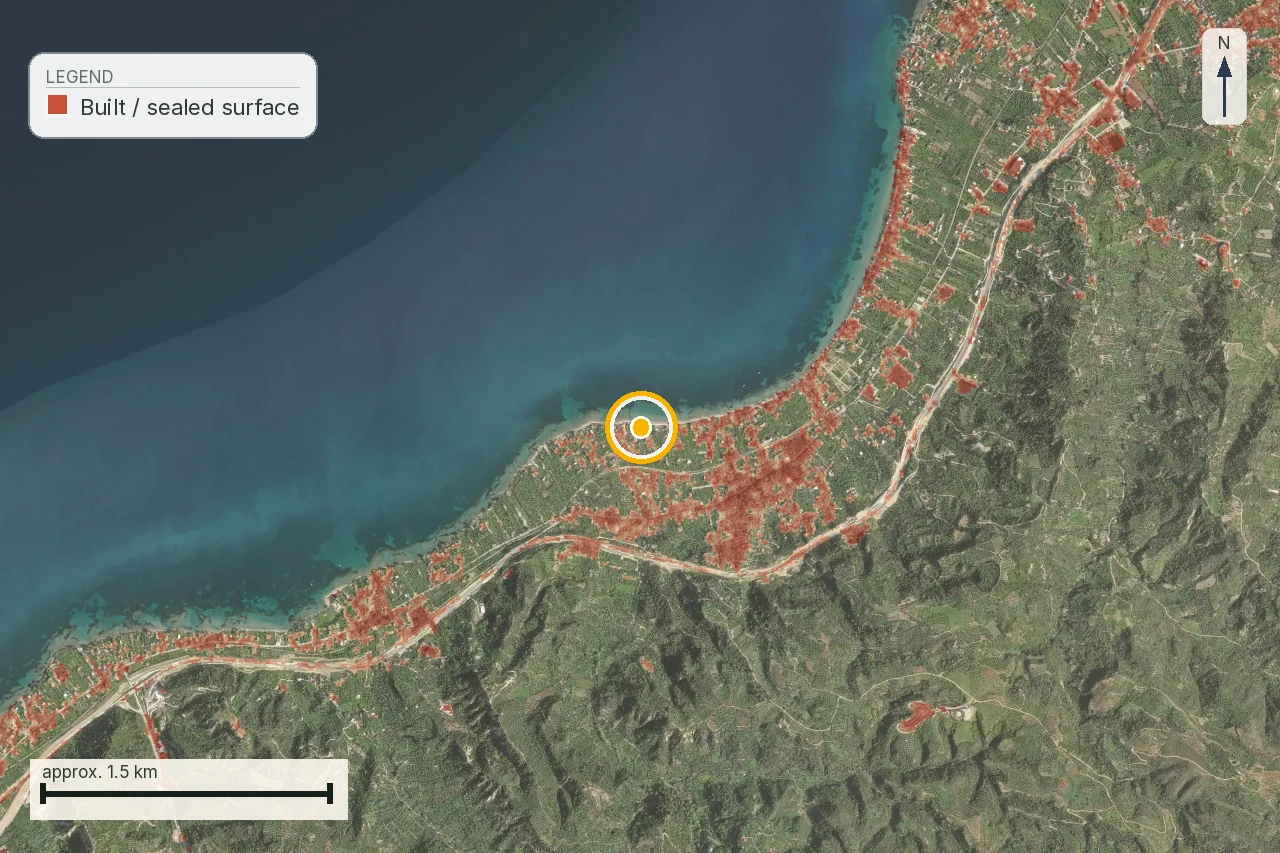
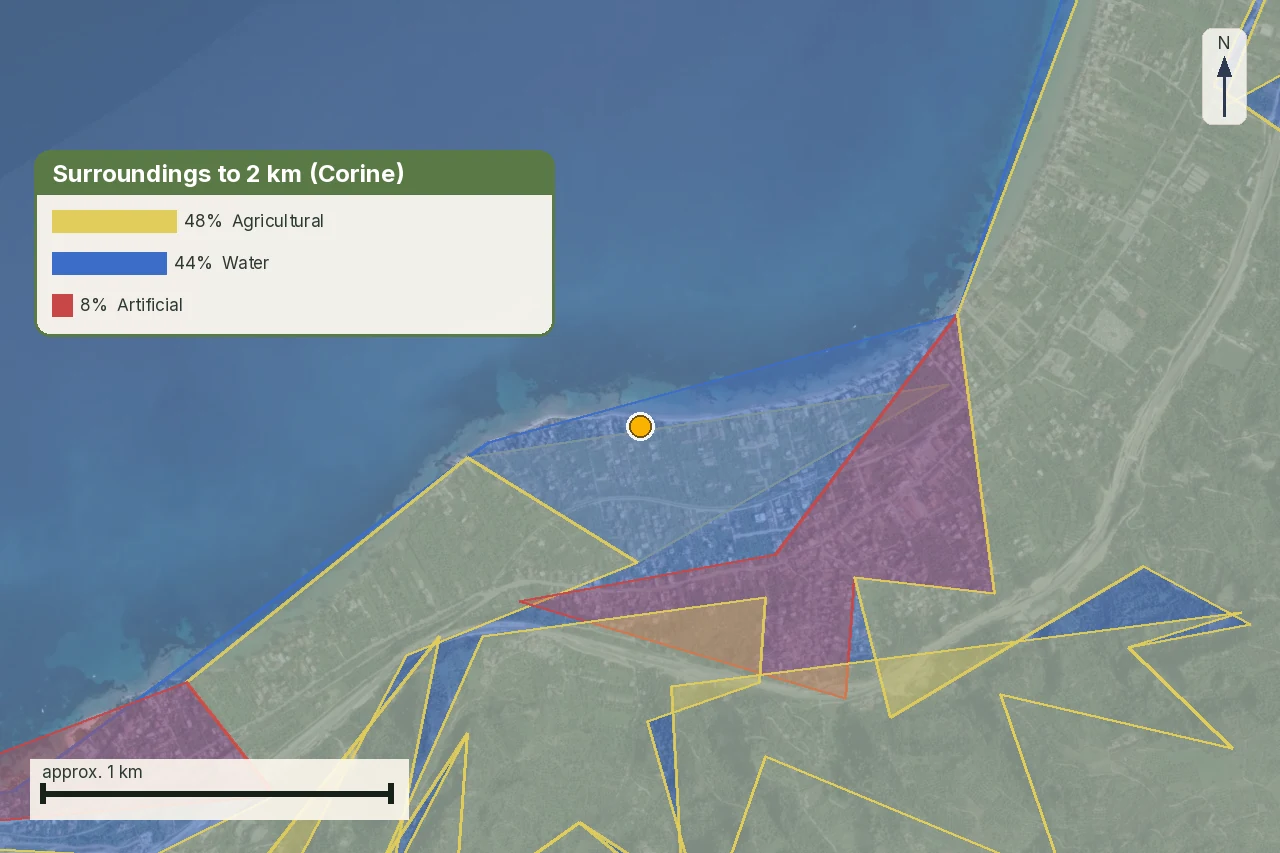
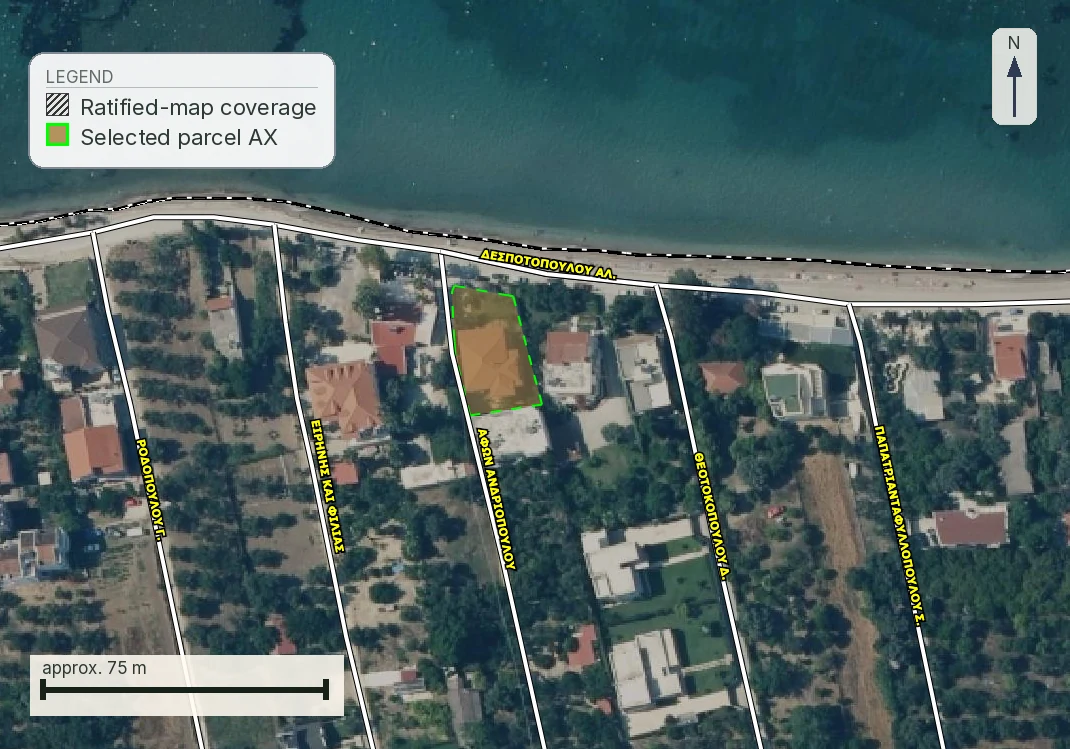
A LandCheck report shows, for the parcel you pick, the cadastral outline and area, forest maps, the foreshore line, land use and natural hazards, with source and date for each map. It does not certify that the plot is buildable; your engineer does that. Check the plot in a LandCheck report → · Read a full sample report
Step by step before the preliminary agreement
- Area from the cadastre, not from the listing. Ask for the KAEK and the cadastral diagram extract (απόσπασμα κτηματολογικού διαγράμματος). Listings round up; the cadastre does not.
- Frontage: length along the road and the legal character of the road, confirmed in writing by the engineer.
- House area under article 256 for plots of 4,000–8,000 m², using the cadastral area.
- Under 4,000 m²: which exception applies, what proves the plot's creation date, and until when.
- Constraints: forest map, foreshore, streams, archaeology, special decrees.
- Make the deposit conditional on the engineer's written opinion if any of steps 2–5 is open.
If you are buying from abroad
You will need a Greek tax number (ΑΦΜ) and usually a Greek lawyer; a notary signs the final contract. The engineer is the person who answers the questions in this guide, and many buyers hire one before the lawyer. Send the engineer the KAEK, the listing and any permits the seller has, and ask for a written opinion that covers the minimum plot, frontage, maximum house area and constraints, with the Code articles cited.
Sources
- Law 5306/2026, ratification of the Spatial Planning and Urban Code "Nikolaos Tagaras" (Government Gazette A 88/08.06.2026), taxheaven.gr; oenet.gr, accessed via search engine 2.11.2026.
- Law 5306/2026, article 251 (4,000 m², 25 m frontage), taxheaven.gr; article 256 (186 m², coefficient 0.018), taxheaven.gr; article 438 (transitional provisions), taxheaven.gr, accessed via search engine 2.11.2026.
- Law 5317/2026, building exceptions and extension of planning deadlines, michanikos.gr, accessed via search engine 2.11.2026.
- Council of State case law on frontage on a recognised road, as cited in a Hellenic Parliament document, hellenicparliament.gr, accessed via search engine 2.11.2026.
Common questions
How many stremmata do I need to build outside a town plan?
Under the general rule of article 251 of Law 5306/2026, 4,000 m² (four stremmata) with 25 m of frontage on a public road. Smaller plots can be built on only through an exception.
How big a house can I build on 4,000 m²?
Up to 186 m² under article 256.
And on 7,500 m²?
186 + 3,500 × 0.018 = 249 m².
Does the frontage have to be on an asphalt road?
The test is the road's legal status, not its surface. A recognised public road counts; a private or informal track may not. The engineer confirms it.
Did Law 5306/2026 make out-of-plan building harder?
The Code ratifies and renumbers existing rules. For exceptions and deadlines, Law 5317/2026 also applies; ask your engineer how it affects your plot.
Keep reading
In-plan vs out-of-plan land in Greece: what you can build
What makes a Greek plot buildable: άρτιο, οικοδομήσιμο and the 4,000 m² rule
Planning terms and land use in Greece: reading όροι δόμησης and checking them yourself
The Greek forest map (δασικός χάρτης): codes, αναδασωτέα and how to check a plot yourself
Check this on your own parcel
A LandCheck report shows, for the parcel you pick, the cadastral outline and area, forest maps, the foreshore line, land use and natural hazards, with source and date for each map. It does not certify that the plot is buildable; your engineer does that. EUR 29 total · VAT included.