
Διαβάστε το άρθρο στα ελληνικά.
Solar farm land in Greece: what a producer certificate and a solar lease mean when you buy or lease the field
On this page
Greek farmland for solar: check the RAAEY certificate, connection status, regional power limits and when a long lease binds a new landowner.
This guide is a preliminary screen for a cost or timing question, not legal, surveying, engineering or tax advice; read the full scope and limits before relying on it.
Have a specific plot in mind? The map checks from this guide can be run on it, with source and date, for EUR 29 total · VAT included. Pin it on the map →
Foreign buyers looking at Greek farmland meet two sales lines more and more often. One is "the field has a solar licence". The other is "it is already leased to a solar company for 25 years". Neither is a guarantee of anything until you have checked two public sources and one private document. This guide explains what each claim usually means, where you verify it, and what a long lease does to you as the next owner.
It is about the land you buy or lease out. For solar and wind projects planned near a house you are buying, which raise different questions, see our guide to renewable energy projects near a property.
Start with a dated public record
Greece's energy regulator is the ΡΑΑΕΥ (Ρυθμιστική Αρχή Αποβλήτων, Ενέργειας και Υδάτων, the Regulatory Authority for Waste, Energy and Water; the former RAE). It publishes lists of renewable generation licences and producer certificates that "cease automatically to be valid". A concrete example is the provisional notice following the regulator’s 14 May 2026 meeting: it concerns holders who had not filed a complete request for a Final Connection Offer (Οριστική Προσφορά Σύνδεσης) by 30 April 2026. An earlier provisional and final list did the same for the 31 December 2024 deadline. The regulator cites article 5(8) of law 4951/2022 and article 30 of its certificate regulation, and gives holders on a provisional list 15 days to object.
That is the context for any "licensed" field. A producer certificate is the first step in a permitting chain, and the chain is designed to drop projects that stall.
What a producer certificate is
The producer certificate (βεβαίωση παραγωγού) is governed by article 11 of law 4685/2020, as amended by article 80 of law 4951/2022. Applications go to the regulator in submission cycles set under article 11(2), through its online registry at licensing.rae.gr, which is the "Μητρώο Βεβαιώσεων" Greek searches refer to. The documents required and the procedure are in the Certificate Regulation (decision ΥΠΕΝ/ΔΑΠΕΕΚ/114746/4230, ΦΕΚ Β΄ 5291/2020, as amended).
For a project requiring a producer certificate, subsequent checks include the applicable environmental authorisation, a Final Connection Offer from the grid operator and the installation/operating permissions required for that station. Exempt projects follow a different route; do not apply one licence checklist to every capacity. Law 4951/2022 sets deadlines for each phase, and certificate holders file progress reports so the regulator can check them (article 12 of law 4685/2020 and article 31 of law 4951/2022).
Three things a certificate does not do:
- It gives no right over the land. It is an act of the regulator addressed to the project company. The company's relationship with the landowner is private: a lease, another lawful land-use title or an agreement whose actual legal effect the lawyer must read.
- It does not mean the project will be built. Without a Final Connection Offer there is no grid connection, and the April 2026 notice shows why the current certificate record, any objections and later decisions must be checked, not just an old certificate PDF.
- It does not cure planning or forest problems. If the field is classed as forest on the forest map or lies in a Natura 2000 site, the certificate does not change that. See our guides to the forest map and to Natura 2000.
Where you check a field yourself
The regulator's geospatial map
The ΡΑΑΕΥ publishes a map of existing and planned renewable projects. It is listed on the national open-data portal data.gov.gr as the "Γεωπληροφοριακός Χάρτης ΡΑΑΕΥ", with WMS and WFS services at geo.rae.gr. Layers are split by permit status, and one layer holds polygons of stations under 1 MW that have a polygon registration certificate.
Polygon registration is also relevant to exempt stations: the regulator’s announcement under article 33(6) of law 4951/2022 requires the listed company/station details, a polygon shapefile and a topographic diagram for the specified operating-support or direct-market participation process. It expressly distinguishes already operating exempt stations. A Βεβαίωση Καταχώρησης Πολυγώνου Εξαιρούμενου Σταθμού is not a producer certificate or proof of ownership. So a field can carry a project polygon without appearing in the certificate registry at all.
Step by step:
- Find the parcel on the Hellenic Cadastre map (maps.ktimatologio.gr) by its ΚΑΕΚ, the national cadastral code. Our guide to the KAEK explains how.
- Open the regulator's map and switch on the photovoltaic layers by status.
- See whether a polygon covers or touches the field. Click it and note the project code, the company, the capacity and the status.
- Search that code or company in the online registry and in the lapse lists on raaey.gr. The regulator also has an English section (raaey.gr/energeia/en/), though the lists and the registry are in Greek.
The polygon was drawn by the project company, not by the Cadastre. It can sit over land whose owner never signed anything, because the company declares the project site. If that is your field, ask the seller in writing and then the company.
High-productivity farmland: use the 2022 limits, not the old 1% figure
The decision of 2020 is not the applicable table to take to a new project. Joint ministerial decision ΥΠΕΝ/ΔΑΠΕΕΚ/104605/4389, ΦΕΚ Β΄ 5342/17.10.2022, expressly repeals decision 74123/2971/2020 in article 4. For its conventional PV-station framework of up to 1 MW on high-productivity farmland, article 2 uses 0.5% for island regions and 0.8% for the other regions, based on the stated 2017 cultivated/fallow-land totals and a standard conversion of 14 stremmata per MW. These are regional planning calculations, not permission to cover that percentage of your own field.
For a hypothetical regional unit in the 0.8% category with 1,200,000 stremmata, the area basis is 1,200,000 × 0.008 = 9,600 stremmata. At 14 stremmata per MW, that corresponds to about 685.7 MW in the illustrative calculation. At 0.5%, the same assumed area gives 6,000 stremmata and about 428.6 MW. For a real location, use the published regional table and the operators’ remaining-capacity statement; do not derive a grid offer by measuring spare fields.
The joint HEDNO/IPTO announcement of 7 March 2025 implements the 2022 decision. It explains that, where the relevant cap is exhausted, the operators stop processing or reject the specified new/pending Final Connection Offer applications on high-productivity land. It also preserves examination of stations on other land or legally exempt from the restrictions. That dated table is an example of where to check, not a guarantee of capacity still available in November 2026. Ask the relevant operator for the current position before agreeing a price or lease condition.
There are statutory qualifications. Article 38 of law 5184/2025 excludes stations in the specific programme «Φωτοβολταϊκά στο χωράφι» from the 0.8% calculation. It also addresses installations above 1 MW with agricultural cultivation, a study and implementing conditions. This does not mean that any farmer, ordinary solar tenant or large station qualifies automatically. Have the engineer identify the exact route and any implementing act before relying on an exception.
Who classifies the land matters too. Article 56(6) of law 2637/1998, in the text reproduced by the 2025 amendment, identifies the regional agricultural authority; an applicable planning act can also designate high-productivity land. The actual 1988 Naxos decree labels zone 1 δ as such. Give your engineer the precise location and ask for the classification act or authority document, together with the connection position. Our land use guide explains the map/document comparison.
The lease: when it binds you as the next owner
Solar land leases run for decades. Greek civil law has a rule every buyer of a leased field should know. Under article 618 of the Civil Code (Αστικός Κώδικας, ΑΚ), a lease of real property for more than nine years is valid against a new owner if it is made by notarial deed and registered (μεταγραφή). Where the Cadastre is operating, registration means entry at the cadastral office.
Article 614 ΑΚ deals more generally with a lease proved by a document of certain date and the new owner's position under it. What applies to a privately signed 25-year lease that was never registered is a question for your Greek lawyer, with the lease in hand. Do not assume either answer.
What to check:
- Cadastral-sheet copy (κτηματολογικό φύλλο): Mitos lists €9.50 for the first sheet and €4.50 for each additional sheet. It lists registered leases, surface rights and other encumbrances. Ordering it online needs Greek Taxisnet credentials; if you have none, your lawyer orders it.
- The lease itself. Term, start date, rent, indexation, the tenant's right to assign, what happens if the project is never permitted, who removes the plant at the end, and from when the full rent is payable.
- Who holds the certificate. Whether the company holding the producer certificate is the same company that signed the lease.
- Anything else signed. A preliminary lease or exclusivity letter can bind the seller without showing in the Cadastre. Ask for every document the seller has signed with any developer.
Doing the sums on the term
Take a hypothetical contract expressly starting on 1 March 2023 and ending on 29 February 2048, a 25-year term; 2048 is a leap year. A purchase on 1 November 2026 leaves 21 years and four months to the end of the term. If the contract gives the tenant a further ten-year option, check the agreed extension ending in February 2058. Read the option’s conditions, not just the headline duration. These are assumed contract dates, not a legal conclusion about a particular lease.
If you are abroad
- Everything is in Greek. Lease, certificate, lapse lists and cadastral sheet. Have a Greek lawyer review the lease and an engineer check the field, and keep the Greek originals next to any translation.
- Signing from abroad. If you plan to sign from abroad, ask your Greek lawyer which power of attorney (πληρεξούσιο) is accepted for that specific property and act, and have the draft checked before signing it.
- Border regions. Some Greek regions require approval before a non-EU buyer acquires land. Check our guide to buying in a border zone before you commit.
A LandCheck report shows the parcel's Cadastre boundary and area, the regulator's renewable permit layers on and around the field, forest maps, Natura 2000 and the planning layers, each with its source and date. It does not review leases, value land or give legal advice. Check the field in a LandCheck report → · Read a full sample report
When the answer is bad
A project polygon covers the field and nothing was signed. Note the code and company from the map, get a written statement from the seller, and contact the company. A dispute about the project polygon is a separate issue from the 15-day objection period offered to affected certificate holders in the cited provisional-lapse notice. Ask your lawyer which procedure applies to your actual dispute.
The seller’s certificate appears on a lapse list. Obtain the current record and the later decision or outcome of any objection. Do not pay a premium for a supposedly active authorisation on the strength of an old PDF. A provisional list is an alert to resolve, not a substitute for checking the final/current status.
The lease is a private 25-year agreement. Get a written opinion from a Greek lawyer on articles 614 ff. and 618 ΑΚ before paying a deposit.
The field is high-productivity land and the regional cap is full. Ask the operator and engineer whether this application is refused under the 2022 framework or fits a legally established exception. Make the transaction conditional on the required written answers; a favourable lease alone does not create grid capacity.
Sources
- data.gov.gr, RAAEY geospatial-map catalogue and WFS capabilities, data.gov.gr; geo.rae.gr, read 2 November 2026.
- RAAEY, provisional notice for the 30 April 2026 deadline, raaey.gr, read 2 November 2026.
- RAAEY, final list for 31 December 2024, raaey.gr, read 2 November 2026.
- Law 4951/2022, articles 31, 33(6), 80, api.et.gr, read 2 November 2026.
- Producer Certificate Regulation, full original Gazette B 5291/2020, api.et.gr, read 2 November 2026.
- RAAEY, progress-report template, raaey.gr, read 2 November 2026.
- RAAEY, polygon registration announcement, raaey.gr, read 2 November 2026.
- Decision 104605/4389/2022, articles 1–5 and regional table, api.et.gr, read 2 November 2026.
- Law 5184/2025, article 38, api.et.gr, read 2 November 2026.
- HEDNO/IPTO, joint announcement and remaining-capacity table, 7 March 2025, deddie.gr, read 2 November 2026.
- Civil Code, articles 614–618, Gazette A 164/1984 (original text), api.et.gr, read 2 November 2026.
- Greek Bar Associations plenary, published Civil Code, articles 614–618, page 208, olomeleia.gr, read 2 November 2026.
- Naxos decree, zone 1 δ, api.et.gr, read 2 November 2026.
- Mitos, cadastral-sheet copy and per-sheet charges, mitos.gov.gr, read 2 November 2026.
Common questions
What is the "Μητρώο Βεβαιώσεων" I see in Greek listings?
The regulator's online registry where producer-certificate applications are filed and certificates are recorded, at licensing.rae.gr.
Does a producer certificate on a field make it worth more?
It does not itself establish a sale value or the developer’s right to occupy the field. Check the current authorisation, connection position and land-use agreement before treating the offer as income-producing solar land.
How big a solar plant is allowed on high-productivity farmland?
The 2022 decision covers its up-to-1 MW framework, with regional capacity limits. The 2025 statutory amendment contains programme and cultivation-related qualifications. The engineer must identify the applicable route; neither "1 MW" nor a percentage alone is an approval.
Does a 25-year lease have to be signed before a notary?
To be valid against a new owner, a lease over nine years must be a notarial deed and registered, under article 618 ΑΚ.
Can I see the lease in the Cadastre?
If it was registered, yes: it appears on the cadastral sheet. An unregistered lease does not. This guide is a preliminary screen, not legal advice, and it does not replace your Greek lawyer or engineer.
Keep reading
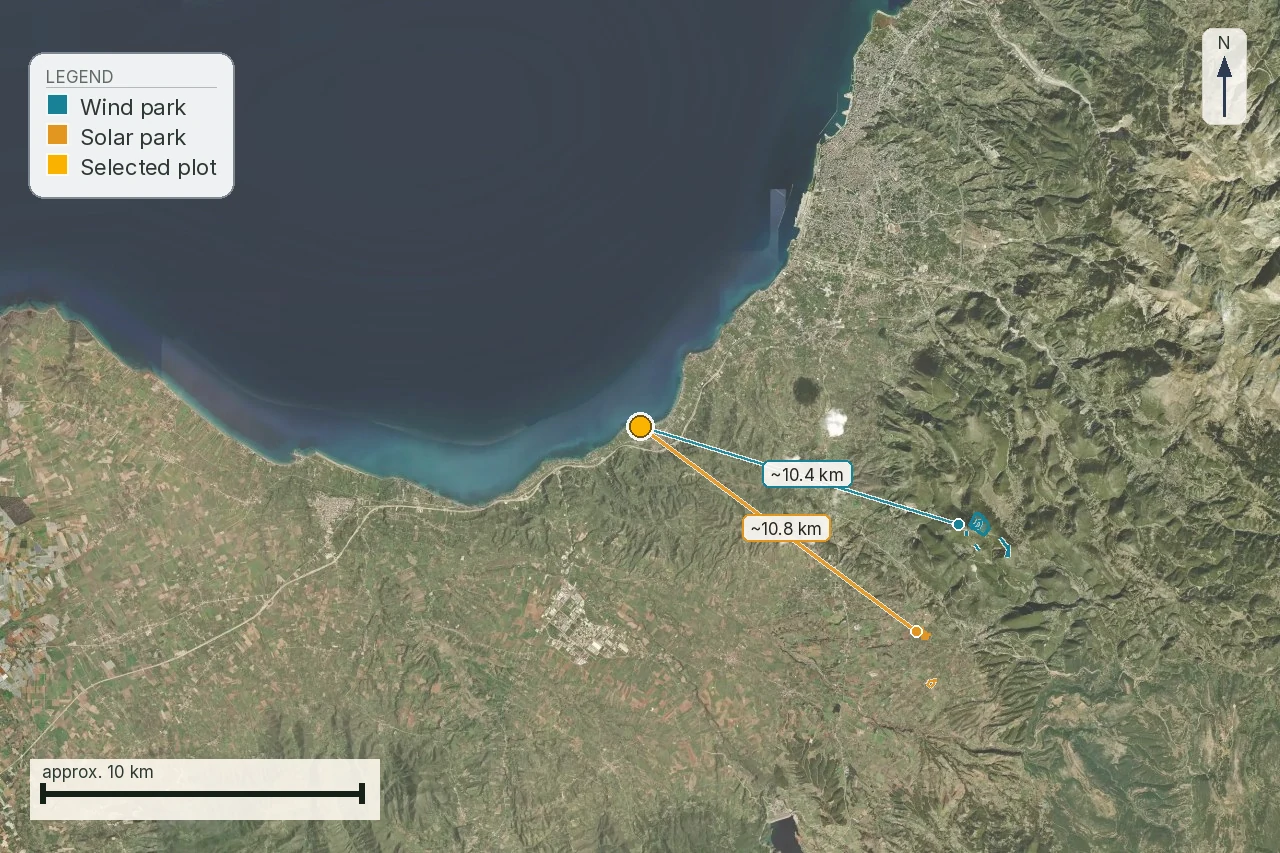
Renewable energy projects near Greek property: the 2008 decision, the 2026 draft and a real parcel
Buying agricultural land in Greece: the checks before you pay
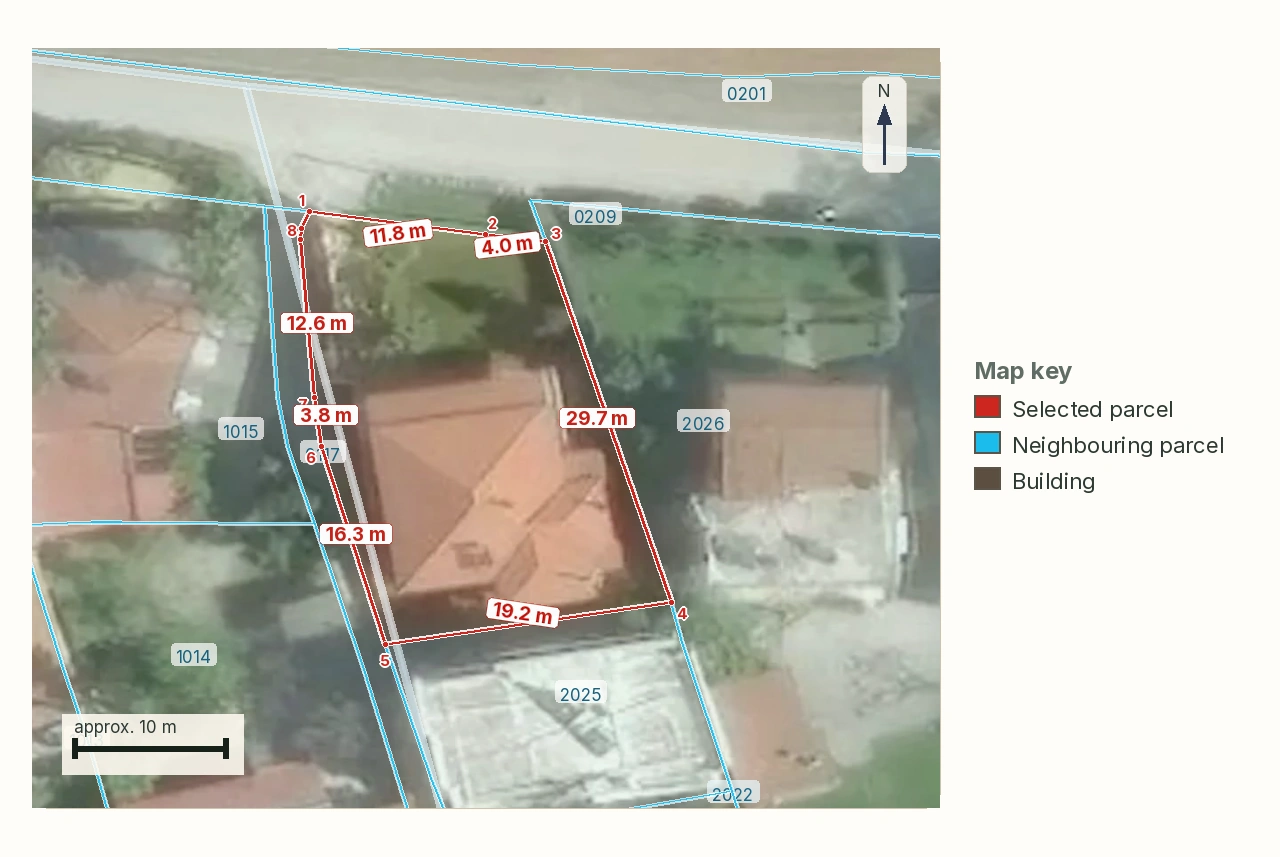
ΚΑΕΚ and the Greek cadastre: reading the code, and the deadline behind it
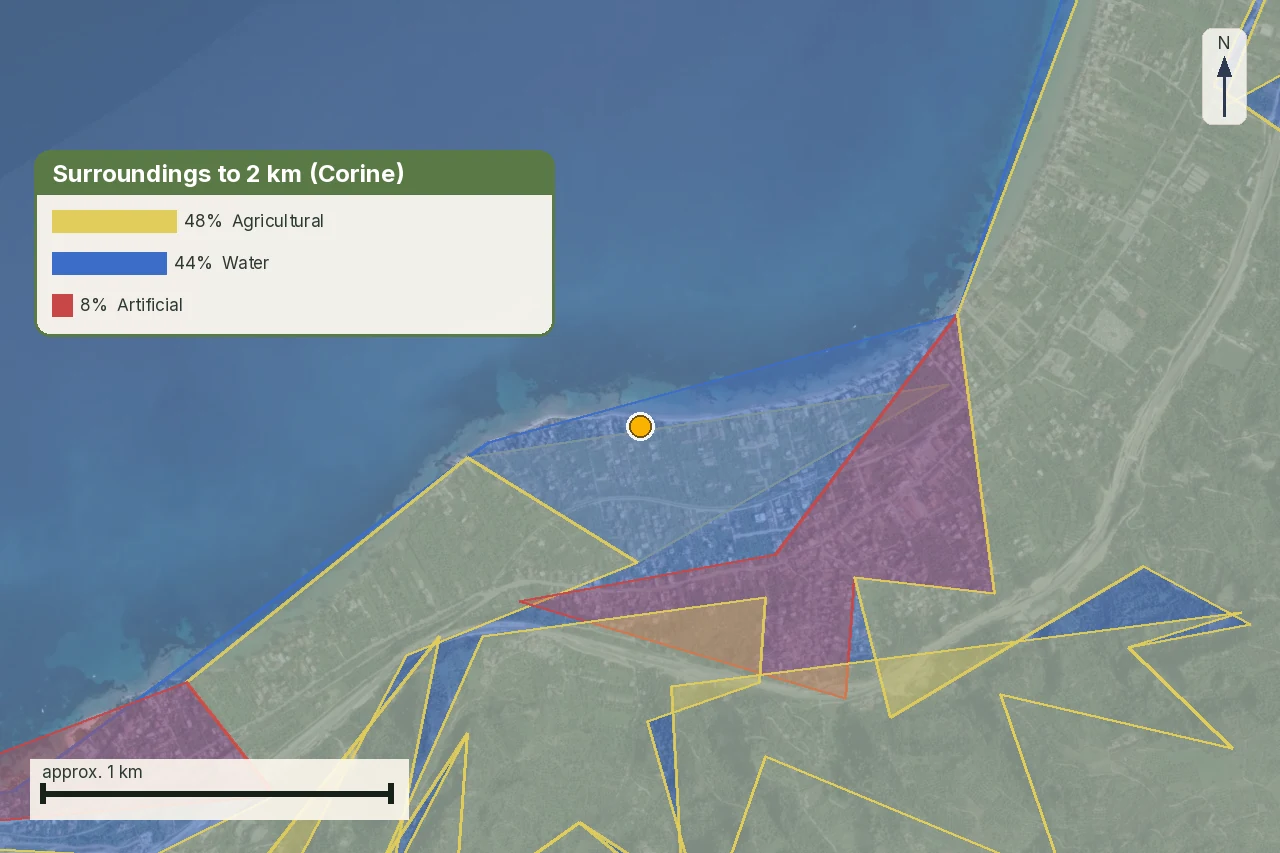
Planning terms and land use in Greece: reading όροι δόμησης and checking them yourself
Check this on your own parcel
A LandCheck report shows the parcel's Cadastre boundary and area, the regulator's renewable permit layers on and around the field, forest maps, Natura 2000 and the planning layers, each with its source and date. It does not review leases, value land or give legal advice. EUR 29 total · VAT included.